Subversion
The Strategic Weaponization of Narratives.
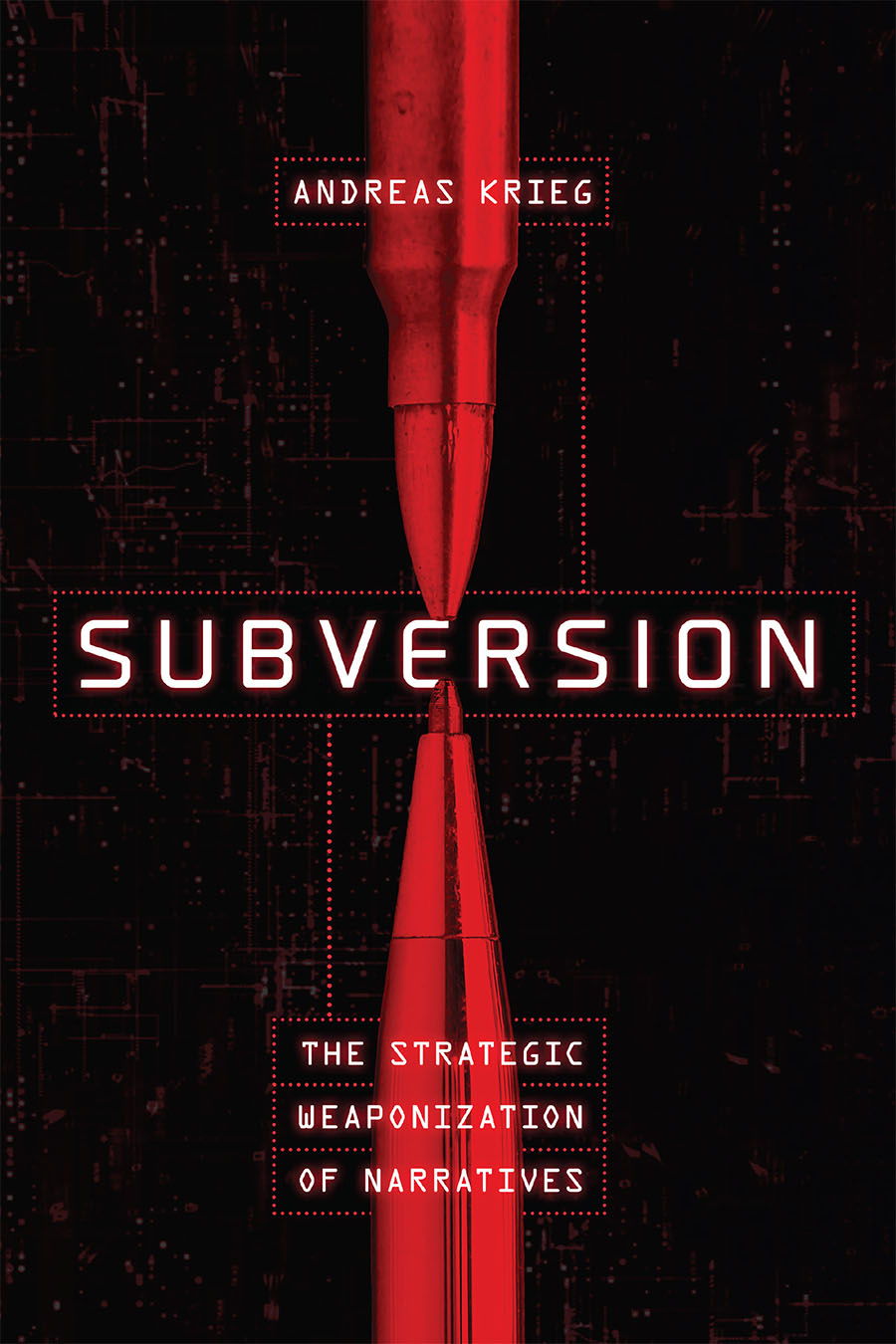
1) Citation
Krieg, Andreas. Subversion: The Strategic Weaponization of Narratives. Georgetown University Press, 2023. Hardcover ISBN 978-1-64712-335-2. 252 pages. (Publisher metadata)
2) Executive Summary
-
Krieg frames subversion as strategic weaponization of narratives: instrumentalizing information to influence/destabilize political outcomes, often below open war. (pp. 14–16, 98)
-
Subversion works by exploiting vulnerabilities across three domains—sociopsychological, infrastructural, physical—converting information effects into real-world political outcomes. (pp. 14, 22–23, 98)
-
The information age changes statecraft because information infrastructure and “authority” are increasingly privatized/dispatched to private entities, enabling plausibly deniable influence through public–private assemblages. (p. 15)
-
Strategic competition becomes persistent (“unpeace”) and narrative-centric; hard power alone cannot secure success when victory is about “whose story wins.” (pp. 16–17)
-
Krieg distinguishes subversion from lower-grade influence by placing it on a continuum defined by (a) mobilization effect (from discourse to policy shift) and (b) orchestration across domains; only high mobilization + high orchestration produces subversive outcomes. (pp. 19–20)
-
Subversion can function as a means of warfare when tied to political ends, aimed at wills, and producing spillover into physical/policy domains—sometimes yielding cumulative “death by a thousand cuts” effects rivaling kinetic operations. (pp. 20–21, 90, 92)
-
The book proposes a six-step approach—orientation → identification → formulation → dissemination → verification → implementation—to describe how campaigns move from mapping grievances to influencing policy-relevant behavior. (pp. 96–97)
-
Case studies of Russia and the United Arab Emirates illustrate how authoritarian actors build information networks of surrogates (media, experts, think tanks, lobbyists) to pollute discourse, undermine trust, and influence decision-makers. (pp. 21, 130–152, 157–180)
-
Krieg argues China, Russia, and Gulf actors exemplify digital authoritarian learning, exploiting “liberation technology” (social media) for surveillance, censorship, and narrative control rather than merely shutting the internet down. (pp. 104, 116–126)
-
His policy bottom line is information resilience: liberal societies must detect/withstand/recover from weaponized narratives via education/media literacy, platform/algorithm reforms, transparency on funding, and selective deterrence—without abandoning liberal constraints. (pp. 186–190, 194, 198–200, 204)
3) Central Thesis + Purpose
-
Thesis
- Krieg argues that subversion—strategic weaponization of narratives via networked information power—exploits sociopsychological, infrastructural, and physical vulnerabilities to alter attitudes, decisions, and behaviors in ways that disrupt sociopolitical consensus and can create war-like strategic pressure below the threshold of conventional war. (pp. 14, 21, 98, 206)
-
The author’s purpose / research question (cited)
- To explain how weaponized narratives exploit vulnerabilities across the information environment (including digital infrastructure) and to outline how states/societies can build resilience against subversion. (pp. 14, 22–24, 187)
-
Claimed contribution (cited)
- Provides an integrated framework linking sociopsychology of truth (ch.1), erosion/contestation of truth gatekeepers (ch.2), subversion as a contest of wills plus an operational six-step model (ch.3), and two illustrative case studies (Russia, UAE), culminating in a resilience-centered counterstrategy. (pp. 22–24, 96–98, 130–132, 157–158, 186–188)
4) Argument Spine
-
Humans do not process “truth” neutrally; cognitive shortcuts, social identity, emotions, and truth bias make audiences vulnerable to compelling narratives. (pp. 26, 32, 36, 40, 42)
-
Traditional gatekeepers of truth (media, experts, academia) are contested and weakened; sensationalism and the erosion of filtering contribute to a degraded epistemic environment. (pp. 46, 54, 56–58)
-
Social media infrastructures (big data, microtargeting, algorithmic curation, echo chambers) amplify selective exposure and repetition effects, making “constructed” consensus easier to manufacture. (pp. 64–66, 70)
-
In this environment, information becomes “power in itself,” enabling subversion as a stand-alone lever to pursue political objectives. (pp. 16, 98)
-
Subversion is strategic (requires political purpose + strategy) and networked (information networks blending direct, indirect, and coincidental surrogates), enabling influence/destabilization with plausible deniability. (pp. 15, 93–95)
-
Campaigns follow a process logic (orientation → identification → formulation → dissemination → verification → implementation) that moves from diagnosing grievances/biases to pushing narratives into policy-relevant arenas. (pp. 96–98)
-
Digital authoritarians learned to exploit “liberation technology” by co-opting online mobilization tools (trolls/bots, censorship, content manipulation) for domestic control and exportable subversion tactics. (pp. 104, 112, 116–126)
-
Russia and UAE illustrate how sustained narrative operations can pollute discourse, mobilize/demobilize publics, and influence policymaker decisions—effects that can accumulate into “war-like” strategic pressure. (pp. 21, 138–140, 180–182, 210–212)
-
Because attribution, legality, and deterrence are difficult, the practical counter is information resilience: harden sociopsychological, infrastructural, and physical nodes against narrative weaponization while maintaining liberal constraints. (pp. 186–188, 190, 194, 197, 204)
5) Key Concepts & Definitions
-
Subversion: a “stand-alone lever of power” that exploits sociopsychological, infrastructural, and physical vulnerabilities for influence or destabilization. (p. 98)
- Role in argument: defines the phenomenon the book theorizes, maps, and tests via cases and resilience recommendations. (pp. 14, 21–24, 186–188)
-
Weaponized narratives: narratives engineered to exploit an audience’s sociopsychological/emotional state and shape decisions/behavior, including through manufactured consensus in echo chambers. (pp. 14, 215)
- Role in argument: the primary “munition” of subversion campaigns across domains. (pp. 13–14, 96–98)
-
Information environment: a global information ecosystem shaping social/political life and offering multiple domains in which narratives operate. (p. 1)
- Role in argument: the operational battlespace for subversion and the object of resilience. (pp. 14–16, 187)
-
Sociopsychological vulnerabilities: cognitive limits/shortcuts (bounded rationality) and predispositions that shape how audiences accept narratives. (p. 32)
- Role in argument: explains why audiences can be mobilized/demobilized by narratives. (pp. 22, 97)
-
Infrastructural vulnerabilities: weaknesses in the information architecture (media systems, platforms, algorithms) that shape dissemination/consumption of information. (pp. 22, 46)
- Role in argument: explains how narratives scale, target, and persist in the public sphere. (pp. 64–66, 192–194)
-
Physical domain / spillover: the movement of informational effects into physical activism or policy-relevant decision-making. (pp. 21, 197)
- Role in argument: crucial threshold for subversion to become strategically consequential (and potentially war-like). (pp. 19–21, 92)
-
Mobilization effect: degree to which narrative operations move from discourse to offline activism or strategic policy shift. (p. 19)
- Role in argument: one axis distinguishing influence operations from subversion. (pp. 19–20)
-
Orchestration: extent to which an operation is coordinated across domains (virtual → physical/policy). (p. 19)
- Role in argument: subversion requires multidomain orchestration, not isolated messaging. (pp. 19–20, 93–94)
-
Reflexive control: “deliberate influence on an adversary…inclining him to make a decision predetermined by the controlling party.” (p. 85)
- Role in argument: micro-mechanism explaining how subversion targets “will” rather than coercing directly. (pp. 14, 93)
-
Information networks (heterarchical): network-centric, heterarchical engagements with target audiences that combine multiple surrogate types. (pp. 15, 93)
- Role in argument: provides the organizational form enabling plausible deniability and reach. (pp. 15–17, 94–96)
-
Surrogates (direct, indirect, coincidental / “useful idiots”): information networks combine surrogates with varying degrees of control/autonomy; coincidental surrogates can voluntarily carry narratives. (pp. 93, 95)
- Role in argument: explains how states operationalize subversion without overt state fingerprints. (pp. 15, 93–96)
-
Gatekeepers of truth: media filter/craft information into limited messages reaching the public (and experts/academia likewise shape epistemic authority). (pp. 46, 56)
- Role in argument: subversion exploits contested gatekeeping and trust erosion. (pp. 46–50, 62–64)
-
Echo chambers: algorithmic/social sorting can create bounded information spaces that reinforce narratives. (p. 66)
- Role in argument: infrastructure for manufactured consensus and polarization—amplifying subversion’s impact. (pp. 66, 215)
-
Truth bias: default tendency to “trust others to tell the truth,” predisposing people to align with perceived consensus. (p. 42)
- Role in argument: sociopsychological predisposition that subversion can exploit through repetition and social proof. (pp. 42, 66)
-
Repetition-related truth effect: repetition can make information seem true even against biases/partisanship. (p. 66)
- Role in argument: explains why persistent narrative repetition is strategically valuable in subversion. (pp. 66, 144)
-
Liberation technology: digital platforms enabling rapid organization/mobilization of civil society (e.g., early Arab Spring dynamics). (pp. 104, 112)
- Role in argument: sets up the contest between emancipatory tech and authoritarian exploitation. (pp. 104–106, 116)
-
Digital authoritarians: regimes that treat civil-societal activism as subversive and exploit digital tools (censorship, manipulation, cyber surrogates) to control discourse. (pp. 104, 116)
- Role in argument: demonstrates how authoritarian learning transforms “liberation” infrastructures into resilience/control and exportable subversion capability. (pp. 116–126)
-
Information resilience: resilience defined as the “ability…to detect, prevent…withstand, handle and recover from disruptive challenges,” applied to sustaining information-psychological stability under weaponized narratives. (p. 187)
- Role in argument: the recommended defensive posture for liberal societies facing subversion. (pp. 186–190, 204)
6) Mechanisms / Causal Logic
-
Mechanism 1: Cognitive susceptibility → narrative uptake → conditions
-
Claim: bounded rationality, social identity dynamics, emotions, and truth bias predispose audiences to accept/align with narratives. (pp. 32, 36, 40, 42)
-
How it works: narratives that resonate with predispositions can bypass deliberation and become socially reinforced “truth.” (pp. 40–42)
-
Conditions: higher salience under polarization/identity conflict and when perceived consensus forms. (pp. 42, 215)
-
-
Mechanism 2: Infrastructural amplification → virality & selective exposure → conditions
-
Claim: microtargeting, algorithmic curation, echo chambers, and repetition effects make manufactured consensus scalable. (pp. 64–66)
-
How it works: targeted delivery + repeated exposure increases perceived truth; trolls/bots can further inflate visibility and intimidation. (pp. 66, 68, 120)
-
Conditions: weak/contested gatekeeping and low trust in mainstream institutions. (pp. 46–50, 62–64)
-
-
Mechanism 3: Networked orchestration via surrogates → plausible deniability & reach → conditions
-
Claim: information networks blend direct, indirect, and coincidental surrogates, allowing states to coordinate narratives without overt attribution. (pp. 15, 93–95)
-
How it works: a subverting actor controls key nodes while granting autonomy to the broader network, enabling organic-looking diffusion. (pp. 95–96)
-
Conditions: access to media/expert/policy pathways (e.g., think tanks, lobbyists) that connect discourse to decision-making. (pp. 96–98, 197)
-
-
Mechanism 4: Six-step campaign logic → sustained influence/destabilization → conditions
-
Claim: orientation/identification map grievances & vulnerabilities; formulation crafts resonant narratives; dissemination & verification propagate/adjust; implementation pushes effects into physical/policy realms. (pp. 96–98)
-
How it works: iterative feedback (verification) adapts messages to maintain traction and expand mobilization effect. (pp. 96–97)
-
Conditions: sustained resources and multi-domain orchestration (e.g., Russia/UAE case applications). (pp. 144–146, 172–178)
-
-
Mechanism 5: Spillover into physical/policy domain → strategic outcome → conditions
-
Claim: subversion becomes strategically consequential when informational effects alter collective behavior or policymaking, potentially producing secondary violence. (pp. 90, 92, 197)
-
How it works: narratives translate into protests or elite decision shifts; even limited direct violence can trigger large-scale reciprocal state/civil violence. (pp. 90–91)
-
Conditions: high mobilization + orchestration and access to policy-relevant conduits. (pp. 19–21, 196–197)
-
7) Evidence, Cases, and Illustrations
-
2013 Egypt coup / counterrevolution narrative campaign: UAE backing plus weaponized narratives helped mobilize Egyptians against Mohamed Morsi, facilitating Abdel Fattah el-Sisi and the military’s takeover. (pp. 12–13)
-
What the author uses it to show: subversion can move from information space to decisive physical/political outcomes via narrative-driven mobilization. (pp. 12–14, 90)
-
How strong is the inference? My assessment: Krieg presents a plausible narrative-mobilization pathway, but the book also flags causal attribution as difficult in general. (pp. 12–13, 92)
-
-
Soviet “active measures” / neutron bomb information operations (1977–78): illustrates subthreshold information warfare exploiting grievances to undercut policy plans. (p. 74)
-
What the author uses it to show: subversion is not new; Cold War precedents demonstrate strategic depth of narrative operations. (pp. 74, 83)
-
How strong is the inference? My assessment: presented as illustrative history; strong for demonstrating concept lineage, less about isolating causality to a single operation. (pp. 74, 83)
-
-
Arab Spring as liberation-technology mobilization: the book uses Mohamed Bouazizi’s self-immolation and networked diffusion of protest narratives to show digital mobilization dynamics. (pp. 102, 112)
-
What the author uses it to show: social media as force multiplier (smart mobs) and the rapid movement from virtual discourse to physical activism. (pp. 110–112)
-
How strong is the inference? My assessment: strong as descriptive mechanism of mobilization; the book treats it as a foundational example for later authoritarian adaptation. (pp. 102–112)
-
-
Authoritarian infrastructure control (China): tools like the Great Firewall/“Great Cannon” exemplify infrastructural measures to censor/manipulate information flows. (p. 118)
-
What the author uses it to show: authoritarians learned to counter and co-opt liberation technology rather than remain vulnerable to it. (pp. 116–118, 126)
-
How strong is the inference? My assessment: strong for illustrating infrastructural control; the book uses it as part of a broader pattern of “digital authoritarian” learning. (pp. 116–126)
-
-
Russia: election interference and strategic objectives: the book frames Kremlin denial and long-term investment in influence/subversion affecting elections. (pp. 130, 152)
-
What the author uses it to show: subversion campaigns aim to pollute discourse, delegitimize institutions, and shape will—consistent with Russia’s concept of war. (pp. 136–140)
-
How strong is the inference? My assessment: persuasive for showing intent and method; policy-outcome causality remains hard to measure, consistent with the author’s own caveat. (pp. 92, 138–140)
-
-
Russia: surrogate ecosystems (RT/Sputnik, “useful idiots,” European influence): examples include state media networks and coincidental surrogates amplifying Kremlin narratives. (pp. 146, 148–150)
-
What the author uses it to show: heterogeneous surrogate networks convert narratives into broader political traction and perceived legitimacy. (pp. 93–95, 146–148)
-
How strong is the inference? My assessment: strong as an account of dissemination architecture; harder (and acknowledged) to quantify downstream behavioral/policy shifts. (pp. 92, 146–150)
-
-
UAE: securitization of political Islam (“conveyor belt” logic): UAE frames Islamists as an existential threat and broadens terrorism definitions to justify counterrevolutionary narratives. (p. 162)
-
What the author uses it to show: how a mid-sized state uses metanarratives (stability/tolerance) to reshape regional and Western discourse. (pp. 166–168)
-
How strong is the inference? My assessment: strong for mapping narrative framing and objectives; causal leverage on external policy varies by target and conduit. (pp. 166–168, 180)
-
-
UAE: think-tank/lobbying pathways into policy arenas (UK Muslim Brotherhood inquiry): UAE-linked narratives and influence networks allegedly shaped UK-level inquiry dynamics and framing. (p. 180)
-
What the author uses it to show: physical-domain subversion is most strategically potent when it enters policy-relevant circles (think tanks/lobbyists/policymakers). (pp. 196–197)
-
How strong is the inference? My assessment: strong as an argument about mechanism (policy conduits); the book notes donor influence can vary and is not always direct. (pp. 180, 197)
-
-
COVID-19 conspiracies and information crisis (5G): shows how “alternative facts” and conspiracies can generate real-world action (e.g., attacks on infrastructure) and strategic distraction. (pp. 206–208)
-
What the author uses it to show: crises widen vulnerabilities; lies wrapped in narratives can generate “truth effects” and polarization. (pp. 208, 214–215)
-
How strong is the inference? My assessment: strong for illustrating sociopsychological vulnerability and spillover; less about attributing campaigns to a single state actor in every instance. (pp. 206–208, 215)
-
8) Chapter/Section Map
Chapter titles are taken from the table of contents. (p. 6)
-
Introduction: frames subversion as strategic weaponization of narratives below war thresholds and defines the vulnerability triad (sociopsychological/infrastructural/physical). (pp. 14–16)
-
Distinguishes subversion from dissent/activism (democracies vs totalitarian regimes) and highlights ambiguity in labeling. (p. 18)
-
Introduces the mobilization–orchestration continuum as a way to separate influence operations from true subversion. (pp. 19–20)
-
Sets the key claim: strategically orchestrated subversion can cumulate into war-like effects (“death by a thousand cuts”) and motivates the Russia/UAE case selection. (p. 21)
-
Provides the roadmap: sociopsychology (ch.1), gatekeepers (ch.2), conceptual model (ch.3), digital authoritarians (ch.4), Russia (ch.5), UAE (ch.6), resilience (ch.7). (pp. 22–24)
-
-
Ch 1 (The Sociopsychology of Truth): opens with a BBC riddle to illustrate how people cling to wrong answers even when evidence is obvious. (p. 26)
-
Develops why “truth” is contested and filtered through cognitive shortcuts and bounded rationality. (pp. 28–32)
-
Explains identity, ideology, and authority effects shaping belief and susceptibility to narratives. (pp. 36–38)
-
Links emotions (fear/anger) to virality and mobilization potential. (pp. 40–41)
-
Defines truth bias and social-consensus dynamics (pluralistic ignorance) as levers for manufactured “truth.” (p. 42)
-
-
Ch 2 (Challenging the Gatekeepers of Truth): defines media gatekeeping as filtering/crafting information into the limited messages reaching the public. (p. 46)
-
Traces how public sphere dynamics (including elite–mass trust and sensationalism) distort epistemic quality. (pp. 48–54)
-
Highlights academia/experts as contested gatekeepers, including vulnerabilities to pseudo-science and epistemic capture. (pp. 56–60)
-
Shows how social media microtargeting and platform architectures enable tailored influence at scale. (p. 64)
-
Explains echo chambers and repetition-related truth effects as infrastructural drivers of polarization and narrative persistence. (pp. 66, 70)
-
-
Ch 3 (Subversion and the Contest of Wills): situates subversion within political warfare and Cold War “active measures” lineage. (pp. 74, 78–81)
-
Distinguishes influence/subversion from coercion by emphasizing will-shaping (reflexive control) rather than direct force. (p. 85)
-
Argues subversion stays under war threshold via limited direct violence but can generate secondary physical violence through mobilization. (p. 90)
-
Specifies conditions for subversion as warfare-like: political purpose, impact on wills, and spillover into physical/policy effects. (pp. 92–94)
-
Presents the six-step approach (orientation → implementation) as an operational model for subversion campaigns. (pp. 96–97)
-
Defines subversion as a stand-alone lever of information power producing disruptive, sometimes violent outcomes. (p. 98)
-
-
Ch 4 (Digital Authoritarians and the Exploitation of Liberation Technology): uses Arab Spring dynamics to show liberation tech enabling rapid mobilization. (pp. 102, 112)
-
Explains the authoritarian counter: infrastructural control (throttling/cutting internet), censorship, and manipulation. (pp. 116–117)
-
Highlights Facebook-era information politics: trolls/bots and performance incentives for cyber surrogates. (pp. 120, 126)
-
Uses China’s Great Firewall/Cannon as an infrastructural-control example. (p. 118)
-
Shows Gulf authoritarian adaptations: cyber-crime laws and suppression of dissent, paired with online surrogate mobilization. (pp. 122–124)
-
-
Ch 5 (Subversion and Russia’s Concept of War in the Twenty-First Century): frames Russia’s “war/peace blur” worldview, including perceptions of Western subversion (color revolutions/Arab Spring). (pp. 136–137)
-
Identifies strategic objectives: pollute information space, erode trust, and influence/destabilize target societies. (pp. 138–140)
-
Applies the six-step approach to Russia: audience targeting (populists), narrative formulation, and dissemination via state media and surrogate networks. (pp. 140–146)
-
Discusses dissemination/verification through repetition and the “sleeper effect,” sustaining narratives over time. (p. 144)
-
Highlights implementation via policy influence and the use of “useful idiots” and elite capture channels. (pp. 148–152)
-
-
Ch 6 (Little Sparta’s Counterrevolution, or How the United Arab Emirates Weaponizes Narratives): frames the UAE’s investment in cyber capability and narrative power as a pillar of security state strategy. (pp. 157, 160)
-
Explains the UAE’s securitization narrative: political Islam framed as existential, enabling broad counterrevolutionary legitimacy. (p. 162)
-
Applies the six-step approach to UAE operations: identifying Western/Arab fault lines, formulating metanarratives of stability/tolerance, and disseminating through media/think tanks/lobbyists. (pp. 168, 172–178)
-
Shows implementation through entry into policy circles (e.g., UK Muslim Brotherhood inquiry) and regional theaters. (pp. 178–180)
-
Concludes that UAE narrative weaponization can shape perceptions and policy despite limited conventional hard power. (pp. 182–183)
-
-
Ch 7 (Toward Information Resilience): defines resilience and argues deterrence alone is limited against subversion. (pp. 186–187)
-
Recommends sociopsychological resilience: education/media literacy and addressing “fault lines”/grievances that subversion exploits. (pp. 189–190)
-
Recommends infrastructural resilience: redesign algorithms to reduce echo-chambering and use inoculation approaches. (pp. 192–194)
-
Recommends physical/policy resilience: transparency on funding and skepticism toward policy-conduit information (think tanks/lobbyists). (pp. 197–198)
-
Adds deterrence-by-denial/punishment and a coordinated strategic hub (including public–private integration) as supporting measures. (pp. 200–202)
-
Ends with a “chain-of-virality” view: multiple nodes (audiences, platforms, journalists, experts) must harden simultaneously. (p. 204)
-
-
Conclusion: uses COVID-era conspiracies to illustrate intensified vulnerability and real-world spillover. (pp. 206–208)
-
Restates subversion as instrumentalization of information to gradually alter sociopolitical consensus/status quo. (p. 206)
-
Emphasizes multi-domain vulnerability mapping and the need for multifaceted response in liberal systems. (pp. 212–214)
-
Warns that once echo-chamber consensus forms, narratives become hard to contest/remove, driving polarization. (p. 215)
-
9) Answers to Seminar Questions
How is subversion both a means and a way of strategic competition?
-
Direct answer
-
Subversion is presented as a stand-alone instrument of power: manipulating information/narratives to achieve political outcomes via influence or destabilization. (p. 98)
-
It is strategically competitive because it must serve a political purpose and be orchestrated by strategy linking ends and instruments. (pp. 93–94)
-
It is a “way” of competition because it operates persistently below war thresholds in an environment of continuous contestation (“unpeace”). (pp. 16, 79)
-
It leverages heterarchical information networks and surrogate ecosystems for reach and plausible deniability. (pp. 15, 93–95)
-
Competitive payoff is measured in mobilization/policy shifts (high mobilization effect + orchestration) rather than battlefield control. (pp. 19–21)
-
-
Supporting passage
- Krieg argues narrative-centric competition changes the logic of success: “whose army wins, but whose story wins.” (p. 17)
-
Limitation/counterpoint
- The book stresses attribution and causal measurement are difficult; proving a specific operation caused a specific policy outcome is “hard to prove and measure.” (p. 92)
-
Discussion question
- If strategic competition is increasingly narrative-centric, what institutional “red lines” would justify escalation or retaliation without overreacting?
Does statecraft operate differently in the present information age?
-
Direct answer
-
Yes: the information environment is increasingly privatized and authority/control dispatched to private entities, changing how states project influence. (p. 15)
-
Statecraft becomes networked: influence requires operating through networks outside core institutions and leveraging indirect surrogates. (pp. 17, 93–95)
-
When victory hinges on narratives, conventional hard power is insufficient; statecraft becomes “statecraft in the age of influence.” (p. 17)
-
Platform architectures (microtargeting/algorithms) enable granular influence at scale, altering the toolkit of statecraft. (pp. 64–66)
-
Defensive statecraft must integrate resilience and public–private coordination rather than rely solely on deterrence. (pp. 187–188, 202)
-
-
Supporting passage
- Krieg’s core statecraft pivot is the privatized information environment enabling deniable influence through private entities. (p. 15)
-
Limitation/counterpoint
- He also emphasizes continuity: information warfare/subversion has Cold War precedents (“active measures”); the novelty is the democratized and digitized scale/context. (pp. 74, 116)
-
Discussion question
- How should democracies integrate private platforms into national strategy without turning “resilience” into state-driven information control?
To what extent is there a difference between coercion and subversion?
-
Direct answer
-
Subversion is framed as will-shaping influence, not direct coercion: reflexive control “inclines” targets to choose what the controlling party preselected. (p. 85)
-
Krieg argues coercion-centric (Clausewitzian) war concepts miss subversion’s nonkinetic logic; he broadens “violence” to include political violence and secondary effects. (pp. 88–91)
-
Subversion stays below war threshold by limiting direct violence, but can generate substantial secondary physical violence through mobilization and reciprocal state response. (p. 90)
-
Distinct mechanism: exploiting sociopsychological and infrastructural vulnerabilities rather than imposing compliance through force. (pp. 14, 98)
-
-
Supporting passage
- Definition of reflexive control: “deliberate influence…predetermined by the controlling party.” (p. 85)
-
Limitation/counterpoint
- Krieg acknowledges the threshold and meaning of violence in the political realm is contested and causal relations are difficult to establish. (pp. 91–92)
-
Discussion question
- If subversion can trigger violent secondary effects, should strategy treat it as coercion-by-proxy—or as something categorically different?
Is the role of information moving states away from coercion to subversion activities?
-
Direct answer
-
Krieg argues information has become “power in itself,” enabling strategic outcomes through manipulation of information environments rather than direct force. (p. 98)
-
Persistent competition below war threshold incentivizes subversion because it offers plausible deniability and operates through privatized infrastructures. (pp. 15–16)
-
When success depends on narrative dominance (“whose story wins”), states privilege influence/subversion tools. (p. 17)
-
Digital infrastructures reduce barriers to influence operations (microtargeting, repetition effects, trolls/bots), making subversion more accessible and attractive. (pp. 64–66, 120, 126)
-
Subversion is not pure substitution: Krieg’s continuum includes subversion supporting military operations, implying complementarity with kinetic power. (p. 19)
-
-
Supporting passage
- Privatized information ecosystems give states new noncoercive pathways to shape outcomes indirectly. (p. 15)
-
Limitation/counterpoint
- The book emphasizes continuity with older political warfare and notes subversion can generate violence as secondary/tertiary effects rather than replacing coercion entirely. (pp. 74, 90)
-
Discussion question
- If subversion complements kinetic power, how should deterrence planning account for cross-domain packages (info + cyber + proxy + kinetic)?
Under what conditions can subversion be as effective as kinetic operations in achieving strategic outcomes?
-
Direct answer
-
When tied to political purpose and integrated strategy (not ad hoc messaging). (pp. 93–94)
-
When it achieves high mobilization effects (offline activism or policy shifts), not merely online noise. (pp. 19, 92)
-
When narratives exploit existing grievances/fault lines so mobilization becomes durable and socially reinforced. (pp. 97, 190)
-
When operations penetrate policy-relevant conduits (think tanks/lobbyists/policymakers), preventing “mere protest” from being the end state. (pp. 196–197, 180)
-
When cumulative effects erode trust and consensus over time (“death by a thousand cuts”), generating strategic pressure comparable to kinetic outcomes. (pp. 21, 210, 215)
-
-
Supporting passage
- Krieg explicitly claims subversion “can be as effective as conventional kinetic operations” (context: war-like strategic effect below threshold). (p. 20)
-
Limitation/counterpoint
- Krieg underscores measurement/attribution problems: proving the causal link from subversive act to policy effect is hard and not simply quantitative. (p. 92)
-
Discussion question
- What indicators would you use to detect when an influence operation crosses into “subversion” with strategic/war-like significance?
How do you respond to the recommendations offered by the author?
-
Direct answer
-
Author’s recommendation: prioritize resilience because deterrence has limited leverage against weaponized narratives; define resilience as detect/prevent/withstand/recover. (pp. 186–187)
-
Author’s recommendation: build sociopsychological resilience via media literacy/education and by addressing societal grievances (“fault lines”) exploited by narratives. (pp. 189–190)
-
Author’s recommendation: reduce infrastructural vulnerabilities by redesigning algorithms to break echo chambers and applying inoculation approaches. (pp. 192–194)
-
Author’s recommendation: increase transparency/controls in the policy realm (funding disclosure, skepticism toward policy-conduit information) while acknowledging liberal constraints. (pp. 197–198)
-
Author’s recommendation: complement resilience with deterrence-by-denial/punishment and build a coordinated strategic hub integrating public and private sectors. (pp. 200–202)
-
My response: the recommendations are internally consistent with his vulnerability triad, but the book itself highlights governance tradeoffs—especially liberal reluctance toward state-driven counternarratives and the risk that regulation becomes an authoritarian blueprint—so oversight and narrow tailoring are essential. (pp. 189, 196)
-
-
Supporting passage
- “algorithms should be redeveloped to allow for more heterogeneous relationships between information and consumers.” (p. 194)
-
Limitation/counterpoint
- Krieg notes liberal systems cannot adopt authoritarian controls (e.g., banning think tanks/NGOs), and foreign funding does not always directly dictate expert output—impact varies. (p. 197)
-
Discussion question
- Where is the line between resilience-building (legitimate governance) and state-driven narrative management (illiberal drift)?
10) Strengths / Weaknesses / Gaps
Strengths
-
Integrates micro (cognition/truth) to macro (statecraft/competition) with a consistent three-domain vulnerability model used across cases and policy recommendations. (pp. 14, 22–23, 98, 187)
-
Provides operationalizable frameworks: mobilization–orchestration continuum and six-step approach. (pp. 19–20, 96–97)
-
Case studies show how surrogate ecosystems translate narratives into policy-relevant influence pathways (think tanks/lobbyists/media). (pp. 96–98, 146–148, 172–178)
-
Explicitly flags measurement/attribution limits rather than overclaiming easy quantification. (p. 92)
Weaknesses / contestable assumptions
-
Many claims rely on narrative effects that the author admits are “hard to prove and measure,” risking inference stretch when moving from correlation to causation. (p. 92)
-
The “act of war” implication is contested inside the book (e.g., legality/legitimacy debates), leaving escalation thresholds and legal categorization underdeveloped. (pp. 21, 186)
-
Recommended measures confront liberal constraints the book itself acknowledges (state counternarratives don’t “come naturally”), potentially limiting implementability. (p. 189)
Gaps / “what’s missing”
-
The book notes subversion is under-addressed in existing legal/strategic frameworks (e.g., not neatly in cyber manuals) but does not build a detailed legal test for when subversion crosses into armed attack/war. (p. 186)
-
China is flagged as strategically important, but the main empirical detail is weighted more heavily toward Russia and the UAE. (pp. 21, 130–152, 157–180)
11) “So What?” for Strategy + This Course
-
Treat narrative control as a strategic center of gravity: when legitimacy and cohesion hinge on shared “truth,” adversaries will target consensus rather than armies. (pp. 17, 215)
-
Subversion is asymmetric: low-cost, deniable operations can create high-cost societal/policy consequences via spillover. (pp. 15–16, 21)
-
Defensive planning should start with vulnerability mapping across sociopsychological, infrastructural, and physical nodes—not just “counter-disinformation.” (pp. 97–98, 187)
-
Deterrence is limited without political acknowledgment and credible response; resilience and denial measures are more realistic baselines. (pp. 187–188, 200)
-
Information power is network power: strategy must track and contest surrogate ecosystems (media, experts, think tanks, lobbyists) that translate narratives into policy. (pp. 93–98, 197–198)
-
Digital authoritarian techniques show how infrastructural control can substitute for overt repression and can be exported as influence capability. (pp. 116–118, 122, 126)
-
Escalation analysis must include secondary effects: subversion can spark political violence and destabilization even if initiators use minimal direct violence. (pp. 90–91, 21)
-
For “information and cyber power,” subversion blurs war/peace and challenges operational/legal thresholds, reinforcing that competition is continuous rather than episodic. (pp. 16, 136, 186)
12) Paper Seed: How I Can Use This Book
Suggested application — comparing the pathways from narrative circulation to action or policy.
Research question: What observable evidence separates a widely circulated influence narrative from subversion that reaches an organized action or a policy decision?
Cases and scope: Compare the Internet Research Agency’s activity directed at the 2016 US election with the UK Muslim Brotherhood Review from its public commissioning in April 2014 to the release of its main findings in December 2015. The first case tests a mass-platform pathway; the second tests the policy-conduit argument associated with the UAE case in the existing notes. Treat foreign influence over the UK review as a proposition to investigate, rather than a premise. Krieg’s publisher describes a six-stage process aimed at effects beyond the information space and identifies Russia and the UAE as the book’s principal state cases. The comparison applies that framework to two different routes through which narratives might acquire strategic consequences. (Georgetown University Press; UK review commissioning; UK review findings)
Working thesis to test: A narrative campaign’s strategic significance depends on the demonstrated connection between its sponsor, intermediaries, and a consequential action or decision. Message volume is a measure of dissemination; it does not establish that an audience changed its behavior or that a policymaker acted because of the campaign. The first and third candidate theses below provide the conceptual foundation, but this design requires separate evidence for orchestration, transmission, adoption, and effects.
Evidence plan: Use the US Senate Intelligence Committee’s social-media report to select a small set of documented campaign examples, including any traceable connection between online messaging and organized activity. For the UK case, compare the commissioning terms, published findings, prime minister’s statement, and the Foreign Affairs Committee’s subsequent scrutiny. Retrospective reports serve as evidence about the bounded episodes, rather than extending their dates. Create the same worksheet for both cases: actor and objective; grievance or vulnerability; intermediary; attributed coordination; observable action or decision; and strength of the causal link. Public lobbying or funding records can corroborate a conduit where available, but a financial relationship alone does not prove control over a conclusion. Compare the proposed mechanism against domestic political incentives, independent security assessments, and ordinary political advocacy.
Paper outline: Define the threshold between influence and subversion; reconstruct the Russian dissemination-to-action pathway; test the alleged policy pathway in the UK review; then compare which links are demonstrated and which remain uncertain. End with resilience measures directed at the demonstrated vulnerabilities, such as transparency of sponsorship and decision processes, rather than treating dissent itself as evidence of foreign manipulation.
Limit: The UK committee identified concerns about the review’s transparency and the perception created by its leadership arrangement, while explicitly reporting no evidence that Saudi Arabia exercised undue influence. That finding neither establishes nor disproves a separate UAE mechanism. Preserve this distinction when evaluating the book’s policy-conduit argument. Neither the existence of an inquiry nor the circulation of election messages establishes the campaign’s ultimate effect on policy or election results. A failure to demonstrate the complete causal chain is a substantive comparative finding. (Foreign Affairs Committee conclusions)
Alternative paper arguments
-
Thesis: Subversion is best understood as networked statecraft below war thresholds that weaponizes narratives to exploit sociopsychological, infrastructural, and physical vulnerabilities—achieving strategic effects through spillover into activism and policy. (pp. 14–16, 19–21, 92, 96–98)
-
Supporting claims from the book:
-
Privatized information environments enable deniable public–private influence assemblages. (p. 15)
-
Subversion is distinct on a mobilization–orchestration continuum and becomes war-like when it affects wills and spills into the physical/policy realm. (pp. 19–21, 92)
-
The six-step approach explains how campaigns progress from mapping grievances to implementation. (pp. 96–97)
-
-
Analytical counterarguments:
-
Inference: “Subversion” may be overinclusive; some cases may be influence/propaganda rather than subversion as defined. (Ground for skepticism: the author’s own thresholding via mobilization/orchestration.) (pp. 19–20)
-
Causal attribution may be too uncertain for strong claims about strategic outcomes. (p. 92)
-
-
Strongest evidence in the book:
- The conceptual thresholds plus process model (continuum + six steps) provide a structured analytic test for “subversion.” (pp. 19–20, 96–97)
-
-
Thesis: Digital authoritarian learning after mass mobilization episodes (e.g., Arab Spring) reversed “liberation technology” into a tool for regime stability and external subversion capability, shifting the strategic balance in information power competition. (pp. 102, 116–126)
-
Supporting claims from the book:
-
Social media accelerated mobilization from virtual domain to physical activism (“smart mobs”). (p. 112)
-
Authoritarian responses include infrastructural controls (censorship, throttling) and narrative manipulation via cyber surrogates. (pp. 116–118, 124–126)
-
Authoritarians pursue resilience through dominant patriotic counternarratives, often backed by coercive measures. (p. 189)
-
-
Likely counterarguments:
- Inference: Some authoritarian “resilience” may be brittle and crisis-dependent, not durable legitimacy. (Book grounding: coercive underpinnings of patriotic counternarratives.) (p. 189)
-
Strongest evidence in the book:
- Concrete infrastructural-control examples and the shift from shutdown to manipulation/mobilization. (pp. 116–118, 126)
-
-
Thesis: Russia’s concept of war treats information operations as continuous strategic action aimed at eroding trust and shaping will; subversion operates through repetition effects and surrogate ecosystems that translate narratives into elite decision influence. (pp. 136–146, 148–152)
-
Supporting claims from the book:
-
Russia views war and peace as blurred; information operations are central to strategic competition. (pp. 136–137)
-
Campaign objectives include polluting information space and destabilizing target societies. (pp. 138–140)
-
Dissemination/verification exploit repetition and sleeper effects, while surrogates (state media and “useful idiots”) expand reach. (pp. 144, 146, 148)
-
-
Likely counterarguments:
- Outcomes are hard to quantify and can be politically contested. (p. 92)
-
Strongest evidence in the book:
- The chapter’s stepwise application of the six-step model to Russian campaigns (targeting → dissemination → implementation). (pp. 140–146, 152)
-
-
Thesis: Liberal information resilience requires combining sociopsychological interventions (education, grievance management) with infrastructural reforms (algorithmic diversity, inoculation) and policy-realm transparency, but these measures face liberal normative/feasibility constraints. (pp. 187–190, 192–198)
-
Supporting claims from the book:
-
Resilience is defined as detect/prevent/withstand/recover; deterrence alone is insufficient. (pp. 186–187)
-
Liberal resilience depends on filling societal fault lines and improving literacy to reduce susceptibility. (pp. 189–190)
-
Platforms should redesign algorithms to reduce echo-chambering and diversify exposure; funding transparency reduces policy capture risk. (pp. 194, 197–198)
-
-
Likely counterarguments:
-
Liberal states are constrained in using counternarratives and hard controls compared to authoritarians. (p. 189)
-
Inference: Overregulation could backfire by delegitimizing institutions and feeding grievance narratives. (Book grounding: concern about politicization and integrity of discourse.) (p. 187)
-
-
Strongest evidence in the book:
- The multi-node “chain-of-virality” concept linking audiences, platforms, and expert/policy nodes. (p. 204)
-
“Evidence blocks”
-
Claim: Subversion becomes strategically decisive when it spills into policy-relevant arenas. (pp. 19–21, 197)
-
Evidence: distinction between protest-level impact and think-tank/policymaker proximity; UAE-sponsored think-tank conferences as higher-risk conduit. (p. 197)
-
Warrant: policy-relevant conduits translate narrative acceptance into state action. (pp. 96–98, 197)
-
Implication: counter-subversion strategy must prioritize transparency/skepticism in elite information pathways, not only public debunking. (pp. 197–198, 204)
-
-
Claim: Repetition + echo chambers enable manufactured consensus and polarization. (pp. 66, 215)
-
Evidence: repetition-related truth effect; “once a consensus builds…narratives can be difficult to challenge.” (pp. 66, 215)
-
Warrant: perceived consensus and social proof can override private doubts (truth bias dynamics). (p. 42)
-
Implication: platform design and inoculation approaches are strategic defensive levers. (pp. 194, 204)
-
-
Claim: Public–private assemblages create plausible deniability for subversion. (p. 15)
-
Evidence: authority/control dispatched to private entities in information age. (p. 15)
-
Warrant: surrogate ecosystems blur attribution while sustaining reach. (pp. 93–95)
-
Implication: governance must address transparency and accountability in private-sector conduits. (pp. 197–198, 202)
-
13) Quote Bank
-
“Subversion in the context of this book is about the instrumentalization of information to gradually alter the existing sociopolitical consensus and status quo.” (p. 206)
-
“Victory today is no longer about ‘whose army wins, but whose story wins.’” (p. 17)
-
“Subversion delivers death by a thousand cuts.” (p. 21)
-
“Distinguishing subversion from legitimate expressions of political dissent is a problem only for democracies; for totalitarian regimes, all opposition is inherently subversive.” (p. 18)
-
“process of culling and crafting countless bits of information into the limited number of messages that reach people each day.” (p. 46)
-
“trust others to tell the truth by default, dubbed the truth bias” (p. 42)
-
“the repetition-related truth effect is more powerful than confirmation bias or partisanship” (p. 66)
-
“deliberate influence on an adversary…inclining him to make a decision predetermined by the controlling party.” (p. 85)
-
“ability…to detect, prevent…withstand, handle and recover from disruptive challenges.” (p. 187)
-
“Subversion…is not principally illegal and it is not even principally illegitimate.” (p. 186)
-
“algorithms should be redeveloped to allow for more heterogeneous relationships between information and consumers.” (p. 194)
-
“once a consensus builds, even if just in an echo chamber, narratives can be difficult to challenge, contest, and remove.” (p. 215)
14) Quick-Reference Index
-
Topics → best pages (cited)
-
Subversion definitions & thresholds (stand-alone lever; consensus assault): (pp. 98, 206)
-
Mobilization–orchestration continuum: (pp. 19–20)
-
Six-step approach to subversion: (pp. 96–97)
-
Sociopsychology: bounded rationality, emotions, truth bias: (pp. 32, 40, 42)
-
Gatekeepers of truth (media/experts): (pp. 46, 56)
-
Microtargeting, echo chambers, truth effect: (pp. 64–66)
-
Digital authoritarian infrastructure control: (pp. 116–118, 126)
-
Russia case mechanics (targeting → dissemination → implementation): (pp. 138–146, 152)
-
UAE counterrevolution narrative mechanics (fault lines → dissemination → policy conduits): (pp. 166–168, 172–180)
-
Information resilience (education, algorithms, transparency, deterrence): (pp. 187–190, 194, 197–200, 204)
-
COVID-19 conspiracies & spillover: (pp. 206–208)
-
-
People/organizations mentioned → best pages (cited)
-
Vladimir Putin: Russia’s threat perceptions and objectives framing. (pp. 138–140)
-
Valery Gerasimov: war/peace blur concept context. (pp. 136–137)
-
Donald Trump administration’s non-acknowledgment of Russian interference as deterrence problem. (p. 187)
-
Hillary Clinton as a reference point in Russia’s perceived threat narrative. (p. 138)
-
Richard Clarke (quoted at Russia chapter opening): framing of Russian political-warfare investment. (p. 130)
-
RT and Sputnik: dissemination surrogates in Russia case. (pp. 146–148)
-
Internet Research Agency: example of troll-farm architecture. (p. 120)
-
Al Jazeera: narrative diffusion and mobilization dynamics in Arab Spring discussion. (p. 110)
-
Mohammed bin Zayed: UAE security-state centralization context. (p. 160)
-
Tamarod: mobilization vehicle in Egypt coup example. (p. 13)
-
NATO: used as an example of low-level influence operation on subversion continuum. (p. 19)
-
77th Brigade: example of a strategic hub model for information operations coordination. (p. 202)
-
Twitter: referenced in regulation/transparency debates (platform response to France law). (p. 196)
-
-
Methods/data sources → best pages (cited)
-
Case-study selection rationale (Russia/UAE) and limits of causal attribution: (pp. 21, 92)
-
Microtargeting and big-data-informed influence: (p. 64)
-
Troll/bot use and online surrogate performance incentives: (pp. 120, 124–126)
-
Six-step analytical framework for campaign tracing: (pp. 96–97)
-
Policy-conduit analysis (think tanks/lobbyists as access points): (pp. 96–98, 197–198)
-
Resilience framework (detect/prevent/withstand/recover) applied to information: (p. 187)
-
Regulatory examples as policy instruments (France, Germany) and tradeoffs: (p. 196)
-
“Chain-of-virality” multi-node defensive concept: (p. 204)
-