Original Sin
Power, Technology, and War in Outer Space
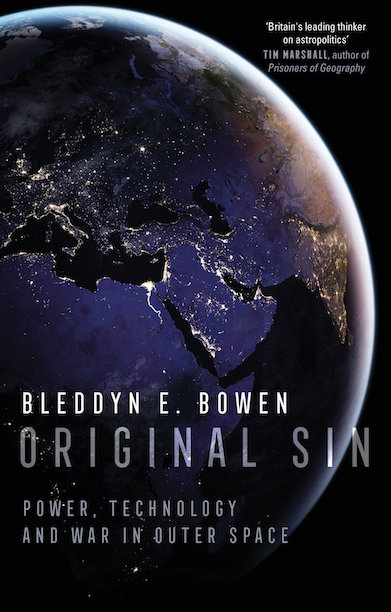
Original Sin
Power, Technology and War in Outer Space
by Bleddyn E. Bowen
Online Description
Bowen’s argument is blunt: the Space Age was militarized at birth, not corrupted later. Rockets, spy satellites, communications systems, navigation constellations, and other orbital infrastructures emerged from military-political projects tied to nuclear war, state-building, and industrial competition, then matured into global systems that now shape conventional war, economic life, and international order. The book’s three-part move is clear: expose the militarized origins of space technology, show how that history diffused globally beyond the superpowers, and then argue that modern space strategy is best understood through command of a “cosmic coastline” rather than fantasies of sanctuary or an “ultimate high ground” (PDF pp. 21-28, 34-37).
Author Background
Bowen locates himself in the book as a scholar at the University of Leicester’s School of History, Politics, and International Relations and as a teacher of astropolitics. He also explicitly frames the book as a synthetic, materialist, technological, and strategic contribution to International Relations rather than a narrow country study or a purely scientific account of space (PDF pp. 9-10, 36).
60-Second Brief
-
Core claim: Space technology’s “original sin” is that it was born from military-political aims—especially nuclear, intelligence, and state power competition—and it remains tethered to those purposes even as it supports civilian and commercial life. Militarization is continuity, not novelty (PDF pp. 17-28).
-
Causal logic in a phrase: military demand -> state-led infrastructure -> structural dependence -> incentives for competition, autonomy, and counterspace (PDF pp. 21-26, 158-195, 244-252).
-
Why it matters for Space Power / strategy:
-
It demolishes the idea that military uses of space are a recent break; that changes how we read current U.S. rhetoric and force design (PDF pp. 16-18).
-
It shifts focus from symbolic “space race” narratives to the hard infrastructure that actually underwrites national power: ISR, SATCOM, PNT, SSA, and launch (PDF pp. 120-195).
-
It treats attacks on space systems as operationally rational because those systems now support terrestrial combat effectiveness, not because states are irrationally “weaponizing” a previously innocent realm (PDF pp. 200-240, 244-281).
-
It pushes strategy away from abstract dominance metaphors and toward command, denial, resilience, and the practical vulnerabilities of an orbital support architecture (PDF pp. 28, 317-324).
-
-
Best single takeaway: If you want to understand space power, stop starting with astronauts and start with missiles, surveillance, logistics, and the political choice to build infrastructure that others will eventually need—or want to disable (PDF pp. 21-28, 120-195).
SAASS 665 Lens
-
How does this text define or illuminate space power? As the use and denial of orbital machines that provide data and communications services to terrestrial political, military, and economic systems; space power is infrastructural, global, and relational, not just symbolic or exploratory (PDF pp. 18-19, 25-26).
-
What does it imply about policy, strategy, posture, or capability? That states should think in terms of command, resilience, denial, and dependence management—not in terms of discovering a suddenly new warfighting domain (PDF pp. 17-18, 27-28, 286-325).
-
What does it imply about history, theory, law, commercial space, Ukraine, China, or allies? Best on sanctuary vs warfighting history; strong on law as permissive management of military use; sharp on commercial space as still state-shaped; directly relevant to Russia/Ukraine and China through reconnaissance-strike complexes and ASAT incentives; especially useful on allied autonomy via Europe, Japan, and India (PDF pp. 60-63, 77-118, 158-195, 222-240, 328-352).
-
What type of book is this in course terms? Primarily history + strategy/theory, with substantial law/policy/commercial applications and direct relevance to China, Russia/Ukraine, and partners/allies.
Seminar Questions (from syllabus)
-
If Bowen is right that space was militarized from the beginning, what is actually new about contemporary U.S. and allied “warfighting domain” rhetoric?
-
Is “cosmic coastline” genuinely a better strategic concept than “ultimate high ground,” or is it mostly a polemical correction?
-
Does Bowen treat space law—especially “peaceful purposes”—as a meaningful restraint, a codification of workable interests, or both?
-
How much does the book’s global history change how we should think about allies, autonomy, and dependence in space?
-
Does the book show spacepower as decisive in war, or mainly as an enabling infrastructure whose value depends on doctrine, logistics, and adaptation?
-
What does Bowen imply about escalation risk when conventional forces and nuclear systems share C4ISR and space support architecture?
-
Does commercial space reduce dependence on states, or deepen geopolitical competition by expanding the infrastructure at stake?
✅ Direct Responses to Seminar Questions
-
Q1. If Bowen is right that space was militarized from the beginning, what is actually new about contemporary U.S. and allied “warfighting domain” rhetoric?
-
The new part is visibility, not essence.
-
Bowen treats recent reorganizations as public recognition of long-standing military realities and vulnerabilities.
-
His point is that Space Force-style rhetoric often mistakes bureaucratic rebranding for strategic rupture (PDF pp. 16-18).
-
-
Q2. Is “cosmic coastline” genuinely a better strategic concept than “ultimate high ground,” or is it mostly a polemical correction?
-
It is better because it highlights adjacency to Earth, vulnerability to Earth-based attack, the supporting/logistical nature of orbital infrastructure, and the fact that command is always partial.
-
The “high ground” metaphor only says altitude confers advantage; Bowen thinks that is too vague to guide force design or campaign planning.
-
The coastline metaphor still remains an analogy, so it clarifies rather than settles strategy (PDF pp. 28, 317-324).
-
-
Q3. Does Bowen treat space law—especially “peaceful purposes”—as a meaningful restraint, a codification of workable interests, or both?
-
Mostly the latter.
-
His core move is to show that “peaceful purposes” became “non-aggressive,” which normalized reconnaissance, communications, and military support functions in orbit.
-
Law matters, but chiefly as a record of politically tolerable military practice, not as proof of sanctuary (PDF pp. 20, 60-63, 286-296).
-
-
Q4. How much does the book’s global history change how we should think about allies, autonomy, and dependence in space?
-
A great deal.
-
Bowen shows that allies and partners repeatedly resisted one-sided dependence on U.S. infrastructure, rules, and industrial terms.
-
Europe, Japan, India, and China all pursued space capabilities partly to escape structural vulnerability, not just to collect prestige (PDF pp. 77-118, 158-195).
-
-
Q5. Does the book show spacepower as decisive in war, or mainly as an enabling infrastructure whose value depends on doctrine, logistics, and adaptation?
-
Enabling first; decisive only in combination.
-
Desert Storm shows how much space can sharpen conventional combat effectiveness.
-
Serbia, Afghanistan, Iraq, and Ukraine show that terrain, concealment, HUMINT gaps, political aims, and adversary adaptation still matter enormously (PDF pp. 202-221, 238-240).
-
-
Q6. What does Bowen imply about escalation risk when conventional forces and nuclear systems share C4ISR and space support architecture?
-
He implies the risk is real and structurally hard to remove.
-
Attacking dual-use support systems can degrade conventional capability while also touching nuclear warning, command, or targeting chains.
-
That makes “limited” counterspace operations harder to keep limited than deterrence-only discussions often admit (PDF pp. 234-240, 286-296).
-
-
Q7. Does commercial space reduce dependence on states, or deepen geopolitical competition by expanding the infrastructure at stake?
-
It expands capacity, but it does not transcend state power.
-
Governments remain regulators, customers, financiers, security providers, and wartime users.
-
Commercial systems can increase resilience, but they also become militarily relevant targets once they carry critical services (PDF pp. 158-167, 329, 336-337).
-
Chapter-by-Chapter Breakdown
Introduction
-
One-sentence thesis: Bowen opens by arguing that current talk of space as a newly contested warfighting domain is historically shallow; the real story is a long, militarized, global space age whose most useful strategic frame is “cosmic coastline,” not sanctuary or “ultimate high ground” (PDF pp. 16-28).
-
What happens / what the author argues:
-
Recent space-force rhetoric creates the false impression that militarization is new (PDF pp. 16-18).
-
The book advances three core claims: space technology’s militarized “original sin,” the global rather than merely bipolar character of the Space Age, and the strategic superiority of the “cosmic coastline” metaphor (PDF pp. 21-28).
-
“Spacepower” is defined as the use and denial of orbital machines that provide data and communications services to earthly systems (PDF p. 18).
-
“Astropolitics” is the political study of any activity in or related to outer space; “technopolitics” captures how technologies embody values and distribute power (PDF pp. 20, 24).
-
The introduction also previews the book’s materialist method and explicit distance from idealized space narratives (PDF pp. 34-37).
-
-
Key concepts introduced: original sin; Global Space Age; astropolitics; technopolitics; spacepower; command of space; cosmic coastline.
-
Evidence / cases used: Space Force rhetoric; allied “operational domain” language; OST idealism; V-2/Mittelwerk legacy; GPS and structural dependence; preview of Russia/Ukraine and China competition.
-
Why it matters for SAASS 665: This is the clearest single setup for the course’s sanctuary-vs-warfighting problem and for any discussion of doctrine, posture, or norms.
-
Links to seminar questions: Q1, Q2, Q3, Q5, Q6.
-
Notable quotes:
-
“The ‘militarisation of space’ is not a new trend in world politics in the twenty-first century—it is a long-established historical fact and present reality.” (PDF p. 18)
-
“Earth orbit is a cosmic coastline.” (PDF p. 28)
-
Part I: The Original Sin of Space Technology
- Part thesis: Part I argues that spacepower began as an extension of nuclear-missile competition and then diffused globally through empires, postcolonial states, alliances, and industrial ambition—not through a clean civil-scientific break (PDF pp. 34-35, 39-118).
Chapter 1: The Dawn of the Global Space Age
-
One-sentence thesis: The Space Age was born from the thermonuclear revolution, missile development, spy-satellite demand, and imperial infrastructure—not from peaceful exploration rhetoric (PDF pp. 39-47, 59-71).
-
What happens / what the author argues:
-
Kennedy’s public language about cooperation masks a reality in which space was already a zone of military competition and exclusion (PDF pp. 39-42).
-
The V-2, Mittelwerk slave labor, Operation Paperclip, and Korolev’s Soviet program tie early rocketry directly to war, coercion, and state power (PDF pp. 42-46).
-
ICBMs and SLVs are shown as technologically adjacent; Atlas, Titan, and R-7 exemplify the missile-space duality (PDF pp. 47-49).
-
NASA was built partly as a civilian “halo” and political screen while the NRO and military programs carried the more consequential security functions (PDF pp. 56-59).
-
The OST did not demilitarize orbit; in practice, “peaceful purposes” came to permit non-aggressive military and intelligence support uses (PDF pp. 60-63).
-
Imperial and colonial geographies mattered: Diego Garcia, Woomera, Pine Gap, and Baikonur all show how terrestrial domination enabled spacepower (PDF pp. 64-71).
-
-
Key concepts introduced: thermonuclear revolution; ICBM/SLV duality; peaceful purposes; sanctuary myth.
-
Evidence / cases used: V-2/Mittelwerk; Paperclip; Sputnik; NASA/NRO split; Corona; OST; Diego Garcia; Woomera; Baikonur.
-
Why it matters for SAASS 665: This chapter is foundational for history, law, and rhetoric. It forces a seminar to separate how states talk about space from why they actually built it.
-
Links to seminar questions: Q1, Q3, Q4.
-
Notable quotes:
-
“Actions, not words, have set the tone for the Global Space Age.” (PDF p. 39)
-
“Space was militarized.” (PDF p. 73)
-
Chapter 2: Beyond Bipolarity
-
One-sentence thesis: The history of spacepower is global: Europe, Japan, China, and India each pursued space capabilities through mixes of autonomy-seeking, development, prestige, and latent or explicit military utility (PDF pp. 77-118).
-
What happens / what the author argues:
-
Western Europe’s path ran through missile politics, failed integration attempts, and eventual autonomy through ESA and Ariane; Britain’s loss of missile autonomy meant loss of launcher autonomy, while France turned nuclear/missile choices into enduring space leadership (PDF pp. 77-89).
-
Japan’s space sector grew through tension between indigenous development and U.S. technology management; cooperation with Washington both constrained and accelerated Japanese capability (PDF pp. 90-95).
-
China’s path was rooted in missile and nuclear primacy; Qian Xuesen, post-1950s politics, and the Long March lineage tie Chinese spacepower to state modernization and military utility from the outset (PDF pp. 96-103).
-
India’s space story is more development-first in tone, but still inseparable from missile latency, nuclear politics, and later military turn (PDF pp. 104-115).
-
Across all cases, autonomy from superpower dependence mattered almost as much as prestige (PDF pp. 116-118).
-
-
Key concepts introduced: postcolonial technonationalism; strategic autonomy; integrated European spacepower; developmental spacepower.
-
Evidence / cases used: Blue Streak/Black Arrow; Diamant/Ariane; ELDO/ESA; Itokawa and NASDA; Qian Xuesen and Long March; ISRO, GSLV, and cryogenic engine politics.
-
Why it matters for SAASS 665: This is the strongest chapter for allies, partners, strategic autonomy, and China/India/Japan as serious space actors rather than supporting cast.
-
Links to seminar questions: Q4, Q6, Q7.
-
Notable quotes:
-
“Rather than imitating the two superpowers, other states charted their own waypoints in space-technological development.” (PDF p. 24)
-
“If Washington’s closest allies will not accept its monopoly on spacepower … what hope is there for the rest of the world to trust in the U.S.?” (PDF p. 117)
-
Part II: The Maturation of Spacepower
- Part thesis: Part II shows that the most consequential achievements of the Space Age were not spectacle missions but the maturation of ISR, communications, navigation, and tracking systems into routine infrastructure for state power (PDF pp. 35, 120-197).
Chapter 3: Applied Witchcraft and Technical Wizardry
-
One-sentence thesis: Secret satellite infrastructures—especially IMINT, SIGINT, and early warning systems—did more to transform modern power politics than crewed spaceflight ever did (PDF pp. 120-155).
-
What happens / what the author argues:
-
Bowen defines the intelligence disciplines relevant to space and proposes “SPACEINT” as intelligence about space itself, not merely intelligence gathered from space (PDF pp. 123-125).
-
Corona and later U.S. systems changed national intelligence, strategic warning, and arms control verification by making the Soviet Union newly visible (PDF pp. 125-133).
-
SIGINT and ELINT satellites expanded the reach of technical collection well beyond visual imagery and tied orbit to naval and missile targeting (PDF pp. 128-137).
-
EO/IMINT spread beyond the superpowers through SPOT, Helios, Chinese, Indian, and Israeli systems, making the infrastructure global (PDF pp. 138-145).
-
Early warning systems such as DSP and their analogues widened military utility beyond nuclear warning into conventional conflict support (PDF pp. 145-151).
-
The chapter repeatedly stresses limits: satellites do not eliminate deception, ambiguity, or the fog of war (PDF pp. 133-145, 151-155).
-
-
Key concepts introduced: IMINT; SIGINT; ELINT; GEOINT; MASINT; SPACEINT; planetary panopticon.
-
Evidence / cases used: Corona; KH-11; NRO-CIA tensions; Soviet Zenit/Yantar; SPOT/Helios; Landsat; RORSAT/EORSAT; DSP.
-
Why it matters for SAASS 665: This chapter is the infrastructure backbone for any discussion of modern military effectiveness, escalation warning, and public-private imagery today.
-
Links to seminar questions: Q3, Q5, Q6, Q7.
-
Notable quotes:
-
“Space technology is not an emerging technology. It is maturing.” (PDF p. 121)
-
“It was as if ‘an enormous floodlight had been turned on in a darkened warehouse’.” (PDF p. 126)
-
Chapter 4: Tethers of Modernity
-
One-sentence thesis: SATCOM, SSA, and GNSS became mature infrastructures that states seek to own—or at least not wholly depend on others for—because those systems create structural power and military-economic leverage (PDF pp. 156-197).
-
What happens / what the author argues:
-
SATCOM grew from military and state requirements into global civilian-commercial infrastructure without shedding its security logic (PDF pp. 158-167).
-
India’s SITE experiment shows both the developmental promise of space and the paternal, political ambiguities embedded in state-led “modernization” through technology (PDF pp. 160-162).
-
Intelsat, European launch autonomy, and later European systems show that allies resisted one-sided U.S. infrastructural dependence (PDF pp. 164-167, 186-194).
-
SSA emerges as both mundane traffic management and military targeting infrastructure, making “spying on space” a major strategic activity in its own right (PDF pp. 168-179).
-
GPS, GLONASS, Galileo, BeiDou, QZSS, and NAVIC illustrate how PNT became critical infrastructure and why states contest dependence on U.S.-controlled services (PDF pp. 180-194).
-
The chapter’s through-line is structural dependence: technologies become “sunk costs” and shape later political options (PDF pp. 156-159, 195-197).
-
-
Key concepts introduced: structural power; space traffic management; SSA; GNSS; PNT; selective availability.
-
Evidence / cases used: Telstar/Syncom; SITE; Intelsat/Intersputnik; Skynet; GSSAP; GPS/Galileo/BeiDou/GLONASS/NAVIC.
-
Why it matters for SAASS 665: This is the most useful chapter for commercial space, public-private integration, alliance politics, and the problem of resilience in a space-dependent force.
-
Links to seminar questions: Q4, Q5, Q7.
Part III: Strategy in the Global Space Age
- Part thesis: Part III argues that once satellites became essential to modern warfighting and economic systems, attacking or defending them became normal strategy—not a futuristic add-on (PDF pp. 35, 198-327).
Chapter 5: Spacepower at War
-
One-sentence thesis: Spacepower became indispensable to modern conventional war through U.S. force enhancement, then diffused into Russian and Chinese modernization—yet it still cannot substitute for strategy, adaptation, or political judgment (PDF pp. 199-240).
-
What happens / what the author argues:
-
The roots of space-enabled warfighting predate 1991 through TENCAP, AirLand Battle, long-range naval strike, and sensor-to-shooter development (PDF pp. 202-205).
-
Desert Storm was a watershed because mapping, GPS, SATCOM, ISR, and precision strike were integrated at scale, even if awkwardly and incompletely (PDF pp. 206-214).
-
Bowen’s critique of the RMA is sharp: the real change was not “information” in the abstract, but the mature integration of orbital and IT infrastructures into terrestrial combat (PDF pp. 215-221).
-
Russia’s post-2008 modernization and China’s informatised joint-force reforms both depend on rebuilt or expanded space infrastructures, especially for reconnaissance-strike complexes (PDF pp. 222-233).
-
Entanglement matters because dual-use C4ISR can make conventional counterspace action touch nuclear warning and command chains (PDF pp. 234-237).
-
Adversaries can adapt: Serbia, Tora Bora, Fedayeen tactics, and the failed Apache raid all show that concealment, dispersion, terrain, and will still blunt high-tech force (PDF pp. 238-240).
-
-
Key concepts introduced: force enhancement; reconnaissance-strike complex; RMA; network-centric warfare; entanglement; tacticisation of strategy.
-
Evidence / cases used: Desert Storm; Bosnia/Kosovo; Afghanistan; Iraq 2003; Crimea; Syria; Kaliningrad; PLASSF/PLARF.
-
Why it matters for SAASS 665: This is the chapter that most directly ties spacepower to current U.S. posture, Russia/Ukraine, and China contingency planning.
-
Links to seminar questions: Q1, Q5, Q6.
-
Notable quotes:
-
“The ‘tacticisation of strategy’” (PDF p. 219)
-
“Spacepower has changed its status … to, at the least, ‘indispensable adjunct.’” (PDF p. 221)
-
Chapter 6: Arsenals for Space Warfare
-
One-sentence thesis: Because satellites now matter, states are rebuilding and proliferating space warfare arsenals ranging from jamming and cyber disruption to kinetic ASATs and co-orbital systems—with Earth-to-space methods remaining the most practical and widespread (PDF pp. 244-284).
-
What happens / what the author argues:
-
The chapter classifies space weapons by basing and target location and by soft-kill versus hard-kill effects; that taxonomy matters because not all counterspace acts have the same strategic or environmental consequences (PDF pp. 244-252).
-
Nuclear ASAT concepts came first; Cold War testing showed both technical feasibility and catastrophic collateral effects in orbit (PDF pp. 259-263).
-
Direct-ascent kinetic ASATs are now the most visible and proliferated class, with the U.S., Russia, China, and India all having demonstrated the principle (PDF pp. 263-270).
-
Electronic warfare and cyber are not secondary sideshows; because satellites are radio-tethered and remotely controlled, soft-kill methods can sometimes have permanent operational effects (PDF pp. 252-258).
-
Space-based/co-orbital systems and close-proximity operations matter most at higher orbits, especially GEO, but they remain expensive and politically risky (PDF pp. 271-280).
-
The chapter repeatedly returns to debris, long-lived environmental damage, and the folly of assuming that banning one weapon class solves the problem (PDF pp. 252, 263-270, 281-284).
-
-
Key concepts introduced: hard-kill; soft-kill; direct-ascent ASAT; co-orbital ASAT; dazzling; scorched orbit; Kessler syndrome.
-
Evidence / cases used: Program 437; Starfish Prime; Nudol; SC-19; Mission Shakti; Peresvet; GEO proximity operations.
-
Why it matters for SAASS 665: Best chapter for escalation, deterrence, debris, legal-norm debates, and capability planning under realistic assumptions.
-
Links to seminar questions: Q3, Q5, Q6.
-
Notable quotes:
-
“Banning one kind of space weapon does nothing to ban the rest.” (PDF p. 252)
-
“Space warfare is merely the continuation of terrestrial politics by other means.” (PDF p. 284)
-
Chapter 7: War on the Cosmic Coastline
-
One-sentence thesis: Space warfare should be analyzed as normal strategy in a littoral support environment; “cosmic coastline” and command of space are better guides than sanctuary, deterrence-only lenses, or “ultimate high ground” rhetoric (PDF pp. 286-325).
-
What happens / what the author argues:
-
Bowen argues that deterrence and arms-control discourse can become analytically distorting if it crowds out ordinary strategic thinking about command, denial, support, and campaign effects (PDF pp. 286-296).
-
He rejects the “ultimate high ground” as strategically empty because it says too little about specific vulnerabilities, routes, chokepoints, and Earth-to-space contestation (PDF pp. 287-289).
-
The “cosmic coastline” metaphor emphasizes adjacency to Earth, supporting/logistical roles, constrained orbital routes, and the possibility of contest by smaller actors (PDF pp. 317-320).
-
“Command of space” matters, but only insofar as it is exploited for terrestrial political purposes; command is partial, not absolute (PDF pp. 320-324).
-
A major payoff of counterspace is to degrade the enemy’s ability to disperse, coordinate, and strike precisely—essentially forcing reversion toward slower, less efficient, more mass-dependent forms of war (PDF pp. 322-324).
-
The chapter ends by normalizing space warfare analytically while refusing to romanticize it politically (PDF pp. 325-327).
-
-
Key concepts introduced: command of space; cosmic coastline; astroeconomic warfare; counterspace in being; Space Pearl Harbor.
-
Evidence / cases used: arms-control debates; ASAT arsenals; Ukraine’s resistance under asymmetric space conditions; maritime and littoral analogy.
-
Why it matters for SAASS 665: This is the book’s most important chapter for theory and doctrine. It directly addresses how to think, teach, and argue about space strategy.
-
Links to seminar questions: Q2, Q3, Q5, Q6.
-
Notable quotes:
-
“Earth orbit should be viewed as a celestial coastline.” (PDF p. 287)
-
“The command of space must in turn be exploited for spacepower to have strategic effects on Earth.” (PDF p. 321)
-
Conclusions: Anarchy in the Global Space Age
-
One-sentence thesis: Spacepower is now a permanent and global feature of international politics, but it remains governed by the same anarchy, competition, and unequal power relations that shaped its origins (PDF pp. 328-352).
-
What happens / what the author argues:
-
Spacepower is now necessity rather than luxury for advanced states and societies (PDF pp. 328-330).
-
The balance of spacepower is not simply unipolar or bipolar; the U.S., China, Russia, India, Japan, and Europe form unequal but significant poles of capability (PDF pp. 335-337).
-
Commercial space expands capacity but remains state-shaped; “private” ownership does not remove systems from geopolitics or wartime targeting logic (PDF pp. 329, 336-337).
-
International society and governance matter, but they operate within anarchy and the interests of major powers (PDF pp. 331-346).
-
Bowen closes by insisting that better politics in space begins with sober diagnosis rather than techno-utopian denial (PDF pp. 346-352).
-
-
Key concepts introduced: anarchy in the Global Space Age; major space powers; state-shaped commercial space.
-
Evidence / cases used: comparative capability tables; megaconstellations; public-private dependencies; governance argument.
-
Why it matters for SAASS 665: This is the payoff chapter for synthesis. It pulls history, theory, law, commercial space, and conflict into one frame.
-
Links to seminar questions: Q4, Q6, Q7.
-
Notable quotes:
-
“Politics is the art of the possible.” (PDF p. 346)
-
“Humanity’s use of outer space is too serious to be left to scientists.” (PDF p. 352)
-
Theory / Framework Map
-
Paradigm(s) / intellectual tradition: Realist and strategic-studies core, fused with materialist technopolitics and global infrastructure history (PDF pp. 24-26, 36-37, 328-346).
-
Level(s) of analysis: Systemic anarchy; state and alliance competition; military-industrial and bureaucratic networks; technological infrastructures.
-
Main causal mechanism(s): Military-political demand drives investment in launch, ISR, SATCOM, PNT, and tracking systems; once built, those systems create structural dependence and new incentives for autonomy, competition, and denial (PDF pp. 21-28, 156-197, 244-252).
-
View of power: Material, infrastructural, and relational; power lies not just in owning hardware but in shaping who gets to use which systems, when, and on whose terms (PDF pp. 25-26, 156-159, 320-321).
-
View of coercion / deterrence / competition: Competition is normal; deterrence matters but is too narrow if it obscures ordinary warfighting incentives and counterspace necessity (PDF pp. 286-296).
-
Role of technology: Technology is socially and politically made, but once entrenched it structures later choices and constraints; the book stresses mature systems over futurist hype (PDF pp. 24-26, 121, 195-197).
-
Role of law / norms: Important, but mostly as codified practice and politically acceptable compromise; law channels militarization more than it abolishes it (PDF pp. 60-63, 286-296).
-
Role of commercial actors: Significant, increasingly central, but never post-political; states remain rule-setters, customers, financiers, and security actors (PDF pp. 158-167, 329, 336-337).
-
Role of allies / partners: Crucial. Autonomy-seeking by Europe, Japan, India, and others is a central driver of spacepower diffusion (PDF pp. 77-118, 186-194).
-
Strongest analytical contribution: Reframing the Space Age as a global, militarized infrastructural order and offering “cosmic coastline” as a more useful strategic metaphor than “ultimate high ground.”
Key Concepts & Definitions (author’s usage)
Original Sin
-
Definition: Space technology’s founding and continuing entanglement with military-political competition, especially nuclear war, intelligence gathering, and state power (PDF p. 21).
-
Role in the argument: It is the book’s master metaphor for continuity across decades and sectors.
-
Analytical note / why it matters: It forces the reader to look for continuity between “civil,” “commercial,” and military systems rather than treating them as cleanly separate.
Global Space Age
-
Definition: The worldwide era in which orbital infrastructures shape political, military, and economic life—not a story reducible to two superpowers (PDF pp. 23-24).
-
Role in the argument: It expands the historical frame and prevents U.S.-centric or Soviet-centric analysis.
-
Analytical note / why it matters: It makes allies, postcolonial states, and diffusion politics central rather than peripheral.
Spacepower
-
Definition: “The use and denial of thousands of machines in Earth orbit” that provide data and communications services for terrestrial systems (PDF p. 18).
-
Role in the argument: It anchors the book’s move from spectacle to infrastructure.
-
Analytical note / why it matters: The emphasis on use and denial makes counterspace intrinsic, not an afterthought.
Astropolitics
-
Definition: The political aspects of any activity in or related to outer space (PDF p. 20).
-
Role in the argument: It justifies bringing IR, strategy, history, and political theory into space analysis.
-
Analytical note / why it matters: It rejects the idea that space is mainly for engineers or natural scientists.
Technopolitics
-
Definition: The political and social values embedded in technologies by their creators and users (PDF p. 24).
-
Role in the argument: It bridges hardware with institutions, interests, and power relations.
-
Analytical note / why it matters: It blocks technological determinism without pretending technology is politically neutral.
Peaceful Purposes
-
Definition: In practice, a Cold War compromise meaning non-aggressive rather than non-military, thereby permitting reconnaissance and support functions in orbit (PDF pp. 60-63).
-
Role in the argument: It undercuts sanctuary narratives and legal idealism.
-
Analytical note / why it matters: Many present debates still stumble over this ambiguity.
SPACEINT
-
Definition: Bowen’s proposed category for intelligence about space itself, rather than intelligence merely gathered from space (PDF pp. 123-125).
-
Role in the argument: It distinguishes SSA/technical tracking from broader strategic interpretation.
-
Analytical note / why it matters: The concept is useful for any force trying to think beyond cataloguing objects and toward intent, posture, and campaign relevance.
Cosmic Coastline
-
Definition: Earth orbit as a littoral, adjunct, support environment whose significance comes from its proximity and intimacy with Earth (PDF pp. 28, 317-319).
-
Role in the argument: It is Bowen’s signature strategic metaphor.
-
Analytical note / why it matters: It yields better questions about support, denial, chokepoints, vulnerability, and command than the “ultimate high ground” cliché.
Command of Space
-
Definition: Control and denial over who can use Earth orbit, to what degree, and with what terrestrial effects (PDF pp. 320-321).
-
Role in the argument: It is the operational-strategic concept that replaces loose dominance rhetoric.
-
Analytical note / why it matters: Command is only meaningful if exploited for political effect on Earth.
Key Arguments & Evidence
-
Claim: Space technology was born from military-political objectives, not universal benefit.
-
Best supporting evidence or cases: V-2/Mittelwerk, ICBM-SLV duality, Corona/NRO, early warning, and the centrality of nuclear competition (PDF pp. 21-22, 42-49, 125-133).
-
Why the claim matters for space strategy: It makes militarization baseline reality, not policy deviation.
-
-
Claim: The Space Age has always been global, not merely bipolar.
-
Best supporting evidence or cases: Europe’s launcher autonomy struggle, Japan’s managed dependence, China’s missile-first path, India’s developmental but latent-military route (PDF pp. 23-24, 77-118).
-
Why the claim matters for space strategy: It forces any U.S. posture to account for allies, emerging powers, and competitive diffusion—not just U.S.-China dyads.
-
-
Claim: The most consequential space achievements are invisible infrastructures, not prestige spectacles.
-
Best supporting evidence or cases: Spy satellites, SIGINT, missile warning, SATCOM, GNSS, SSA, and their diffusion into civil/commercial sectors (PDF pp. 120-195).
-
Why the claim matters for space strategy: Strategy should prioritize resilience and denial of services, not symbolic demonstrations.
-
-
Claim: Space infrastructure changed conventional war by enabling dispersed, networked, precision force.
-
Best supporting evidence or cases: TENCAP, Desert Storm, GPS-enabled maneuver, satellite-supported bombing, later NATO and Russian/Chinese modernization (PDF pp. 202-240).
-
Why the claim matters for space strategy: Satellites are worth attacking because they support the most effective forms of modern military power.
-
-
Claim: Counterspace is proliferating because the payoff is now real.
-
Best supporting evidence or cases: Nudol, SC-19, Mission Shakti, jamming, cyber, lasers, proximity operations in GEO (PDF pp. 244-281).
-
Why the claim matters for space strategy: Debates about “weaponization” miss that warfighting incentives already exist.
-
-
Claim: “Cosmic coastline” is a better strategic frame than “ultimate high ground.”
-
Best supporting evidence or cases: Earth-to-space vulnerability, orbital chokepoints, supporting/logistical roles, the need to exploit command for terrestrial ends (PDF pp. 28, 317-324).
-
Why the claim matters for space strategy: Better metaphors drive better doctrine, force design, and campaign analysis.
-
-
Claim: Law, norms, and commerce do not remove space from power politics.
-
Best supporting evidence or cases: OST’s permissive interpretation, Intelsat/Galileo politics, state-shaped commercial constellations, public funding of “commercial” systems (PDF pp. 60-63, 164-167, 186-194, 329, 336-337).
-
Why the claim matters for space strategy: Governance must be designed for competition, not assumed harmony.
-
⚖️ Assumptions & Critical Tensions
-
Bowen assumes international anarchy remains the decisive background condition for space politics; that gives the book conceptual coherence, but it also predisposes the analysis toward competition and away from stronger claims about transformative governance (PDF pp. 331-346).
-
He assumes states remain the primary strategic actors even as private firms expand; the book repeatedly argues firms are still state-shaped, but the tension with increasingly large commercial constellations is real (PDF pp. 329, 336-337).
-
He assumes Earth orbit will remain the overwhelmingly important zone for military utility in the near term; that is persuasive in the book’s timeframe, but it deliberately brackets more speculative cislunar futures (PDF pp. 28, 317-319).
-
The book’s descriptive strength is greatest where it historicizes infrastructure and capability; its prescriptive guidance is thinner once it turns to “what should be done” beyond realism, recognition, and analytical sobriety (PDF pp. 346-352).
-
There is a built-in tension between demystifying militarization and normalizing space warfare. Bowen wants analytical clarity, not celebration, but some readers will still feel the normalizing effect (PDF pp. 286-327).
-
“Original sin” is a powerful metaphor because it creates continuity, but it can also flatten differences among motives, periods, and institutional uses if pressed too hard (PDF pp. 21-25, 328-346).
-
The book is strongest on infrastructure and strategic logic; it is less interested in the detailed micro-politics of implementation, acquisition failure, or legal negotiation design than a narrower policy study would be.
Critique Points
-
The “original sin” metaphor does major conceptual work, but it sometimes compresses meaningful variation among military, civil, and commercial systems into one historical continuum. That is analytically clarifying, but occasionally too totalizing (PDF pp. 21-25, 328-346).
-
Bowen is excellent at proving that militarization is not new; he is less specific about how policymakers should prioritize among resilience, regulation, alliance burden-sharing, commercial integration, and crisis communications once that premise is accepted (PDF pp. 286-352).
-
The global scope is a strength, but the empirical weight still falls heavily on the major powers. Smaller states and non-state actors appear mostly as subjects of diffusion, hosting, or adaptation rather than as full agenda-setters.
-
The book is sharp on commercial actors as state-shaped, but it does not fully theorize what happens when commercial constellations become both politically influential and operationally indispensable at scale (PDF pp. 329, 336-337).
-
Bowen rightly criticizes “ultimate high ground,” but “cosmic coastline” also has limits; it is excellent for near-Earth warfighting and support, less obviously decisive for a future in which cislunar logistics or industrial activity become real.
-
The critique of RMA-era thought is convincing, but the book’s own discussion of space warfare sometimes leans heavily into weapons taxonomy and campaign logic after warning against tacticising strategy.
-
The book is strongest as diagnosis. Readers looking for granular legal design, alliance governance mechanisms, or acquisition policy recommendations will need companion texts.
-
Bowen’s early use of Russia/Ukraine 2022 is careful, but any judgments about Russian modernization made at that moment are inevitably provisional and now highlight the risk of inferring too much from peacetime modernization narratives.
-
There is a productive but unresolved tension between the book’s materialist stress on infrastructure and its claim that politics can still change outcomes. The first half often feels more fully developed than the second.
Policy & Strategy Takeaways
US space strategy
-
Treat militarization as enduring reality, not as a recent revelation. That should push strategy away from rhetorical novelty and toward sober infrastructure management, resilience, and denial planning (PDF pp. 16-18, 286-325).
-
Doctrine should stop leaning on “ultimate high ground” language and instead think in terms of command, support, denial, and campaign effects (PDF pp. 28, 317-324).
Military posture / capability development
-
Build for degraded operations. Bowen repeatedly implies that forces overly optimized for pristine SATCOM, ISR, and PNT will struggle badly once those systems are jammed, degraded, or partially denied (PDF pp. 234-240, 244-281, 322-324).
-
Protect and diversify the terrestrial segment—ground stations, control links, SSA networks, and data architecture—not just the satellites (PDF pp. 168-179, 244-258).
China / deterrence / competition
-
Assume China and Russia are not merely “catching up” symbolically; they are building space-enabled reconnaissance-strike complexes with real operational implications (PDF pp. 222-233).
-
Counterspace deterrence cannot rest on declaratory statements alone. The book implies a need for resilience, dispersal, redundancy, and credible adaptation if satellites are lost (PDF pp. 244-281, 322-324).
Commercial space integration
-
Commercial capacity is strategically useful, but dependence on it remains political. Procurement, regulation, and wartime targeting logic will all still flow through states (PDF pp. 158-167, 329, 336-337).
-
Public-private integration should be planned as a wartime and alliance-management problem, not sold as an escape from geopolitics.
Law / norms / escalation management
-
Narrow bans on one weapon class will not remove the operational incentives for counterspace, especially with soft-kill tools and attacks on ground nodes available (PDF pp. 252, 286-296).
-
Norm-building is still worthwhile, but Bowen implies it should focus on behavior, debris, transparency, and crisis management with modest expectations.
Allies and partners
-
Allies will seek autonomy in critical infrastructures when dependence feels strategically risky or industrially costly; U.S. strategy should assume that, not resent it (PDF pp. 77-89, 186-194).
-
Shared architectures are politically sturdier when they accommodate diversified provision and meaningful partner agency.
⚔️ Cross-Text Synthesis (SAASS 665)
Sanctuary vs warfighting history cluster
-
Point of agreement: Bowen fits squarely with the course pressure against sanctuary myths; he insists space was militarized from the start (PDF pp. 17-18, 39-63).
-
Point of tension: His emphasis on continuity can leave less room for temporary restraint, ambiguity, or cooperative episodes as analytically central.
-
Why the contrast matters: It forces seminar discussion to separate descriptive history from normative aspiration.
Space law and customary norms cluster
-
Point of agreement: Law matters because it structures what counts as acceptable use and embeds shared expectations (PDF pp. 60-63, 331-346).
-
Point of tension: Bowen treats the legal order less as a shield against militarization than as a framework that normalized “non-aggressive” military support uses.
-
Why the contrast matters: It changes whether policy energy should go primarily into legal prohibition or into resilience, signaling, and practical restraint.
Space power theory cluster
-
Point of agreement: Command matters more than symbolism; spacepower is relational and only strategically meaningful when exploited for terrestrial effect (PDF pp. 28, 320-321).
-
Point of tension: Bowen strongly resists dominance-by-altitude or “high ground” formulations and wants strategy tied to orbital geography and support effects instead (PDF pp. 287-289, 317-324).
-
Why the contrast matters: Doctrinal language shapes acquisition, campaign design, and the kinds of wars leaders imagine.
Commercial space cluster
-
Point of agreement: Commercial actors matter because they expand capacity, bandwidth, imagery, and launch options.
-
Point of tension: Bowen insists “commercial” is often misleading when states remain the biggest customers, financiers, and warfighting users (PDF pp. 336-337).
-
Why the contrast matters: Public-private integration is not post-political; it is a new layer of state power and dependence management.
China / future conflict / deterrence / allies cluster
-
Point of agreement: China is a peer space power because of integrated missile, ISR, SATCOM, and industrial depth—not because of prestige symbolism alone (PDF pp. 96-103, 222-233).
-
Point of tension: Bowen warns against collapsing everything into a U.S.-China duopoly; Europe, Japan, India, and others still matter materially and politically (PDF pp. 23-24, 335-337).
-
Why the contrast matters: Good strategy in SAASS 665 needs to combine deterrence thinking with alliance management and competitive infrastructure politics.
❓ Open Questions for Seminar / Podcast
-
If militarization is old, why does public discourse keep rediscovering it as if it were new?
-
Is “cosmic coastline” best understood as a doctrinal tool, an analytical metaphor, or a policy intervention against bad rhetoric?
-
How much counterspace is enough to change terrestrial campaign outcomes before nuclear entanglement becomes intolerable?
-
Does megaconstellation growth reinforce Bowen’s argument about structural power, or does it weaken it by making denial harder?
-
How much strategic autonomy in space is enough for allies before duplication becomes wasteful?
-
Can law realistically do more than channel and slow militarization when the infrastructures at stake are already dual-use and operationally essential?
-
Does commercial imagery and SATCOM make coalition warfare easier, or escalation management harder?
-
If spacepower mainly supports terrestrial war, should “space strategy” always be subordinate to theater strategy rather than treated as an independent domain logic?
-
What does Ukraine suggest about fighting effectively with asymmetric space access but strong external support?
-
Where, if anywhere, does Bowen leave genuine room for a more equitable space order beyond realism plus diagnosis?
✍️ Notable Quotes & Thoughts
-
“The ‘militarisation of space’ is not a new trend in world politics in the twenty-first century—it is a long-established historical fact and present reality.” (PDF p. 18)
-
“Spacepower is the use and denial of thousands of machines in Earth orbit.” (PDF p. 18)
-
“Space is not some new environment that transforms our social and political world.” (PDF p. 17)
-
“Earth orbit is a cosmic coastline.” (PDF p. 28)
-
“Space technology is not an emerging technology. It is maturing.” (PDF p. 121)
-
“Banning one kind of space weapon does nothing to ban the rest.” (PDF p. 252)
-
“Space warfare is merely the continuation of terrestrial politics by other means.” (PDF p. 284)
-
“Humanity’s use of outer space is too serious to be left to scientists.” (PDF p. 352)
Podcast Hooks
-
3 opening angles
-
The book’s real provocation: the Space Age did not drift from peace to war; it began in war.
-
A lot of space talk starts with astronauts. Bowen starts with missiles, slave labor, spy satellites, and nuclear targeting.
-
Space Force rhetoric sounds new until Bowen makes you realize Washington is about seventy years late to the diagnosis.
-
-
3 book-vs-course comparison angles
-
Bowen versus the sanctuary/warfighting cluster: continuity, not rupture.
-
Bowen versus law/norms discussions: legal language often ratifies usable military practice rather than abolishing it.
-
Bowen versus commercial-space optimism: private actors widen the game, but states still set the stakes.
-
-
3 productive disagreements or tensions worth discussing aloud
-
Does “original sin” illuminate continuity, or does it flatten too many differences?
-
Is “cosmic coastline” a real doctrinal advance, or mostly a better way to say satellites are vulnerable support systems?
-
Does analytically normalizing space warfare sharpen strategy, or subtly narrow the policy imagination?
-
-
1 concise closing takeaway for the episode
- Bowen is strongest when he shows that space power is really about controlling and contesting the infrastructure that makes modern states richer, faster, and more lethal.