Rocket Dreams
Musk, Bezos, and the Inside Story of the New, Trillion-Dollar Space Race
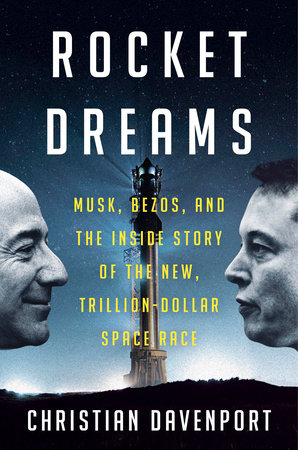
Rocket Dreams
Musk, Bezos and the Trillion-Dollar Space Race
by Christian Davenport
Online Description
Christian Davenport’s Rocket Dreams argues that commercial space is no longer a speculative sideshow or a mere support arm of national policy. Reusable launch, founder capital, NASA procurement, and China’s steady lunar push have fused into a new contest over who can build the infrastructure of the next space age: launch systems, transport, communications, lunar logistics, and eventually in-space industry. Musk and Bezos matter here not just as colorful billionaires, but as strategic actors whose firms now shape U.S. capability, pacing, and risk. (PDF pp. 17-19)
Author Background
Christian Davenport has been a longtime Washington Post reporter, most recently covering NASA and the space industry; the bio in this edition also notes an Emmy for work on SpaceX’s first human spaceflight mission, a Peabody for reporting on veterans with traumatic brain injuries, and multiple Pulitzer-finalist reporting teams. That background shows: this is strongest as deeply sourced strategic reportage rather than formal theory. (PDF p. 364)
60-Second Brief
- Core claim: The new space race is no longer state-only and no longer mainly symbolic. It is a competition to build reusable, affordable, strategically useful space infrastructure—and the actors that do that fastest will shape U.S. power, lunar access, and the rules of the road. (PDF pp. 17-19, 223-229)
- Causal logic in a phrase: Reusability + private capital + government contracts + China pressure = real competition over cislunar infrastructure.
- Why it matters for Space Power / strategy:
- It shows why commercial firms are now integral to national capability, not optional contractors. (PDF pp. 190-205)
- It reframes the moon as a logistics, resource, and rule-setting problem—not just a prestige target. (PDF pp. 23-29, 223-229)
- It argues that U.S. weakness is often continuity and execution, not imagination. (PDF pp. 143-157, 224-228)
- It makes the sanctuary-to-warfighting shift concrete through GPS vulnerability, orbital surveillance, and competition over space infrastructure. (PDF pp. 76-83)
- Best single takeaway: In Davenport’s telling, space power goes to the actor that can turn money, engineering, and political access into reliable launch cadence and enduring infrastructure.
SAASS 665 Lens
- How does this text define or illuminate space power? As the ability to build, launch, sustain, and politically organize activity in space at scale. Power here is industrial, logistical, and normative—not just symbolic. (PDF pp. 14-19, 76-83, 223-229)
- What does it imply about policy, strategy, posture, or capability? U.S. strategy cannot treat commercial providers as peripheral; NASA and the Pentagon increasingly depend on them for crew launch, heavy lift, broadband constellations, and lunar systems. Launch cadence, reusability, and manufacturing tempo become strategic variables in their own right. (PDF pp. 32-34, 190-205, 207-221, 294-295)
- What does it imply about history, theory, law, commercial space, Ukraine, China, or allies? History: space is moving from heroic one-off exploration to contested infrastructure. Theory: the book offers an implicit theory of space power based on cost, cadence, and coalition rather than formal doctrine. Law/norms: Artemis Accords function as competitive order-building. Commercial space: this is the book’s center of gravity. Ukraine: indirect relevance only; useful for thinking about how modern conflict depends on space-enabled communications and timing, but not a major case in the book. China: the pacing competitor throughout. Allies: essential for legitimacy and durability. (PDF pp. 76-83, 226-229, 301-304)
- What type of book is this in course terms? Primarily commercial space + U.S. policy/strategy/current posture, with strong China/competition and sanctuary-to-warfighting overlap.
Seminar Questions (from syllabus)
- Does Rocket Dreams portray commercial space as a supporting instrument of state power, or as the new operational center of U.S. space power?
- In this book, what is the moon actually for: prestige, resources, logistics, deterrent signaling, or norm-setting?
- What does Davenport suggest is the real U.S. vulnerability in space—technology gaps, bureaucratic drag, political discontinuity, or overreliance on single firms?
- Does SpaceX’s success strengthen U.S. strategy more than it endangers it? At what point does commercial dominance become strategic dependence?
- How does the book frame China’s rise: as a military threat, an industrial competitor, a norm entrepreneur, or all three at once?
- Are Artemis and the Artemis Accords better understood as exploration policy, coalition strategy, or anti-China statecraft?
- Does the book imply that rapid iteration and accepted failure are now strategically superior to legacy aerospace safety culture—or only viable when disciplined by outside oversight?
✅ Direct Responses to Seminar Questions
- Q1. Commercial space: adjunct or center of gravity?
- The book’s answer is closer to center of gravity than adjunct.
- NASA still sets broad political ends, but firms increasingly own the operational means: crew launch, launch cadence, lunar landers, and communications constellations. (PDF pp. 190-205, 237-252)
- The state still matters through procurement, regulation, diplomacy, and safety review—but the means of execution now sit heavily in private hands.
- Q2. What is the moon for in this book?
- The strongest answer is logistics + resources + rule-setting.
- The South Pole matters because of water, power, and permanent presence, not just flags. (PDF pp. 23-29, 222-229)
- Prestige still matters, but mostly because it helps determine who sets precedents and attracts partners.
- Q3. What is the real U.S. vulnerability?
- Primary vulnerability: continuity and execution.
- The book repeatedly shows strategy getting jammed by delayed rockets, legacy programs, procurement fights, and changing administrations. (PDF pp. 143-157, 224-228, 301-302)
- Industrial weakness matters too—but mostly when paired with political and bureaucratic drag.
- Q4. Does SpaceX strengthen U.S. strategy more than it endangers it?
- Short term: yes. SpaceX restores crew launch, normalizes reusability, and gives Artemis a plausible lander path. (PDF pp. 190-205, 237-252)
- Long term: concentration risk grows as everyone else lags. The book ends with officials effectively needing Blue to become viable so national ambitions are not lodged in one company. (PDF pp. 294-295)
- Best answer: SpaceX is both America’s biggest competitive advantage and a strategic dependency risk.
- Q5. How does the book frame China’s rise?
- As all three: military-relevant, industrial, and normative.
- China appears through ASAT implications, steady lunar and planetary progress, coalition-building, and durable symbolism on the moon. (PDF pp. 17-19, 76-83, 223-229, 301-304)
- The book’s sharper point is continuity: China keeps going while the U.S. keeps resetting.
- Q6. Artemis and the Accords: exploration, coalition, or anti-China statecraft?
- All three, but coalition strategy is the sharpest answer.
- Exploration supplies the public-facing mission.
- Anti-China urgency supplies the strategic rationale.
- The Accords make Artemis harder to kill and more normatively attractive. (PDF pp. 226-229)
- Q7. Is rapid iteration strategically superior to legacy risk culture?
- On speed, cost, and adaptation: yes.
- On human spaceflight: only when heavily disciplined by testing and external oversight. (PDF pp. 174-189)
- The book’s mature answer is not “move fast and break things,” but “move fast, test brutally, and let someone outside the firm force you to close risk.”
Chapter-by-Chapter Breakdown
Introduction: Starship
- Thesis: Starship is the book’s organizing symbol for a strategic break from the old space age: reusable super-heavy lift turns deep-space presence from aspiration into operational problem. (PDF pp. 13-19)
- What the author argues: Blue’s own internal analysis saw Starship as potentially monopolistic; NASA put it near the center of lunar plans; SpaceX and Blue together remade the commercial baseline; China appears immediately as copier, competitor, and future lunar rival.
- Key concepts introduced: Full reusability; monopoly risk; deep-space infrastructure; space economy.
- Evidence / cases used: Starship’s 2024 booster catch and splashdown; Blue’s internal memo; NASA lunar contracts; China’s attempt to emulate the design.
- Why it matters for SAASS 665: It frames the core course problem correctly: the contest is now over transport architecture, not just orbital presence.
- Links to seminar questions: Q1, Q2, Q4, Q5.
- Notable quote: “You need to be looking at your watch, not your calendar.” (PDF p. 15)
Part I: Earth, 2016–2018
This part establishes the new baseline: Trump-era lunar policy returns, Blue tries to insert itself, and SpaceX proves that tempo can overturn legacy assumptions about who actually drives space progress. (PDF pp. 20-101)
Chapter 1: “I Get This Angry Twice in a Year”
- Thesis: Bezos senses the Trump moon turn as Blue’s opening, but the deeper point is that the moon has been reframed from Apollo nostalgia to a resource-rich strategic frontier. (PDF pp. 21-34)
- What the author argues: Bezos wants Blue to pitch NASA hard; Trump’s team embraces a lunar return built on public-private partnership; the South Pole’s water makes the moon operationally useful; the new race includes commercial activity, militarization, and lunar access.
- Key concepts introduced: Lunar South Pole; public-private partnership; “space Olympics”; resource competition.
- Evidence / cases used: Bezos’s Blue Moon proposal; Gingrich/Walker/Navarro moon framing; China’s lunar program and anti-satellite signaling.
- Why it matters for SAASS 665: The chapter makes clear that “why the moon?” is now a strategy question, not a nostalgia question.
- Links to seminar questions: Q1, Q2, Q3, Q5.
Chapter 2: Elon’s Real Superpower
- Thesis: Blue concludes it cannot ignore SpaceX because government contracts have become the lever that turns private innovation into strategic advantage. (PDF pp. 35-45)
- What the author argues: Bezos drops Blue’s earlier aversion to competitor fixation; Blue decides to bid more aggressively where SpaceX bids; credibility with NASA becomes a strategic asset.
- Key concepts introduced: Government money as leverage; credibility with NASA; competitive bidding as strategy.
- Evidence / cases used: Transition-team meetings; rushed lunar white paper; Bezos’s NASA pitch and willingness to fund development.
- Why it matters for SAASS 665: Space strategy is not separable from acquisition and industrial policy.
- Links to seminar questions: Q1, Q3, Q4.
- Notable quote: “Elon’s real superpower is getting government money.” (PDF p. 37)
Chapter 3: Converting the Impossible to Late
- Thesis: Musk’s edge is not just ambition but the willingness to redesign architectures, own infrastructure, and accept failure as the cost of compressing time. (PDF pp. 46-60)
- What the author argues: BFR/Starship is resized to make the economics work; Boca Chica is chosen to permit high-cadence operations; Moon Base Alpha appears beside Mars as part of a reusable transport vision.
- Key concepts introduced: Private spaceport; one-system architecture; launch cadence; iterative development.
- Evidence / cases used: Musk interview; Boca Chica scouting trip; 2017 Adelaide presentation.
- Why it matters for SAASS 665: It shows how industrial control of launch sites and tempo can become strategic advantage.
- Links to seminar questions: Q1, Q3, Q7.
- Notable quote: “At SpaceX, we specialize in converting the impossible to late.” (PDF p. 47)
Chapter 4: On a Jihad
- Thesis: Blue tries to become a real strategic-industrial player—New Glenn, BE-4, Pentagon relevance—but execution and culture lag the vision. (PDF pp. 61-75)
- What the author argues: New Glenn positions Blue as more than a suborbital curiosity; dependence on Russian engines becomes a strategic embarrassment; Bezos pushes decision speed; Bob Smith is brought in to scale the company.
- Key concepts introduced: BE-4; national security launch; decision velocity; organizational scaling.
- Evidence / cases used: New Glenn reveal; RD-180 politics; ULA engine deal; CEO search.
- Why it matters for SAASS 665: The industrial base—and especially engines—appears as a national-security problem, not just a commercial one.
- Links to seminar questions: Q3, Q4, Q5, Q7.
- Notable quote: “We need to get better at that. I’m on a jihad to get better at that.” (PDF p. 72)
Chapter 5: The Dark Side of Space
- Thesis: This is the book’s clearest statement that space is warfighting-relevant infrastructure, not sanctuary. (PDF pp. 76-87)
- What the author argues: Pence’s Space Council links lunar return to strategic competition; officials warn that GPS and other systems are vulnerable; NRO and military space move closer to the foreground; commercial renewal unfolds inside a threat environment.
- Key concepts introduced: Space dominance; GPS vulnerability; NRO; warfighting domain.
- Evidence / cases used: Space Council speeches; warnings about GPS, nuclear effects, and orbital surveillance; Hyten’s public framing.
- Why it matters for SAASS 665: This is the chapter to mine when discussing space as an enabling domain for terrestrial war and national power.
- Links to seminar questions: Q2, Q3, Q5, Q6.
- Notable quote: “There’s a dark side.” (PDF p. 81)
Chapter 6: “I’ll Say You’re Fired in Two Minutes”
- Thesis: Bridenstine enters as the political broker who must reconcile astronaut safety, commercial providers, and White House urgency. (PDF pp. 88-101)
- What the author argues: His interest in space begins through weather forecasting and public utility; he survives a partisan confirmation fight; Space Force politics arrive early; he centers safety and catastrophe avoidance.
- Key concepts introduced: Public value of space; political stewardship; risk culture; Space Force.
- Evidence / cases used: Moore tornado story; Senate hearing; Trump and Pence interactions; Bridenstine’s concern with abort risk.
- Why it matters for SAASS 665: Strategy here is filtered through civilian leadership, Congress, and risk management—not just technology.
- Links to seminar questions: Q3, Q4, Q7.
- Notable quote: “If there’s a catastrophe, the whole world stops.” (PDF p. 101)
Part II: Earth Orbit, 2018–2020
This part turns commercial promise into operational proof: Falcon Heavy, Crew Dragon, and Artemis show how spectacle, engineering, and policy feed one another—and how quickly politics tries to seize the result. (PDF pp. 102-205)
Chapter 7: Starman
- Thesis: Falcon Heavy/Starman matters because it combines technological proof, public imagination, and strategic signaling. (PDF pp. 103-113)
- What the author argues: The launch is high-risk; the Tesla payload is chosen to create a new icon; the successful heavy-lift flight and twin landings stun rivals; China and Europe read it as evidence of real U.S./SpaceX advantage.
- Key concepts introduced: Heavy lift; spectacle as mobilization; strategic signaling.
- Evidence / cases used: Falcon Heavy debut; Starman/Tesla imagery; reactions in Europe and China.
- Why it matters for SAASS 665: Public inspiration and industrial capability reinforce each other; narrative is part of competition.
- Links to seminar questions: Q1, Q5, Q7.
- Notable quote: “There is no point. It’s just for fun and to get the public excited.” (PDF p. 105)
Chapter 8: Flying by Swipe
- Thesis: The Rogan episode crystallizes the central public-private dilemma: how much sovereign trust can the state place in a founder-led firm? (PDF pp. 114-127)
- What the author argues: Musk’s public behavior triggers NASA alarm; Bridenstine orders culture and safety reviews; disputes over fueling reveal deep NASA-SpaceX mistrust; dependence on SpaceX persists anyway.
- Key concepts introduced: Organizational Safety Assessment; “load and go”; founder risk; human-rating.
- Evidence / cases used: Joe Rogan fallout; NASA response; congressional pressure; fueling controversy.
- Why it matters for SAASS 665: Commercial capability can be strategically invaluable and politically destabilizing at the same time.
- Links to seminar questions: Q1, Q4, Q7.
- Notable quote: “The whole world is watching you.” (PDF p. 117)
Chapter 9: Question Everything
- Thesis: SpaceX wins by challenging legacy assumptions, but only after a bruising fight with astronaut culture and NASA habit. (PDF pp. 128-142)
- What the author argues: SpaceX rejects NASA’s docking solution and builds a simpler one; touchscreens replace the control stick; astronauts initially hate it; repeated iteration eventually wins them over.
- Key concepts introduced: First principles; simplification; autonomy; human-machine interface.
- Evidence / cases used: McDocker prototype; simulator debates; astronaut test narratives.
- Why it matters for SAASS 665: Innovation is not just a lab phenomenon—it changes the actual human practice of spaceflight.
- Links to seminar questions: Q4, Q7.
- Notable quote: “Question everything. Everything.” (PDF pp. 128-129)
Chapter 10: By Any Means Necessary
- Thesis: Artemis becomes a political acceleration campaign as much as an exploration program, and SLS delay turns schedule into the central strategic problem. (PDF pp. 143-157)
- What the author argues: Boeing admits more SLS delay; Bridenstine threatens commercial alternatives; Pence moves the landing date to 2024; the “first woman” pledge becomes political and budgetary leverage.
- Key concepts introduced: SLS; deadline politics; schedule as strategy; symbolic representation.
- Evidence / cases used: Bridenstine hearing; Shelby backlash; Pence’s Huntsville speech.
- Why it matters for SAASS 665: The chapter exposes how electoral time and strategic time can collide.
- Links to seminar questions: Q2, Q3, Q6.
- Notable quote: “By any means necessary.” (PDF p. 153)
Chapter 11: Artemis
- Thesis: Bezos and Bridenstine both try to turn the moon into a durable public story—one through settlement vision, the other through program branding. (PDF pp. 158-173)
- What the author argues: Bezos’s “vision speech” ties lunar settlement to O’Neill-style expansion and Blue Moon; Bridenstine brands the program as Artemis to humanize and legitimize it.
- Key concepts introduced: Road to space; O’Neill colonies; program branding; lunar settlement.
- Evidence / cases used: Bezos’s Washington speech; Blue Moon mock-up; Artemis naming sequence.
- Why it matters for SAASS 665: Narratives matter because they mobilize resources, votes, and partners.
- Links to seminar questions: Q2, Q3, Q6.
- Notable quote: “It’s time to go back to the moon. This time to stay.” (PDF p. 168)
Chapter 12: “We Just Blew It to Smithereens”
- Thesis: SpaceX’s path to strategic credibility still runs through unforgiving human-spaceflight safety gates. (PDF pp. 174-189)
- What the author argues: Crew Dragon explodes during testing; NASA and SpaceX clash; parachutes and valves become flashpoints; the successful abort test restores trust.
- Key concepts introduced: Abort system; Mark 3 parachutes; safety oversight; failure as learning.
- Evidence / cases used: April 2019 explosion; Hawthorne summit; January 2020 abort test.
- Why it matters for SAASS 665: Fast-moving commercial actors still need hard external discipline when lives and national programs are on the line.
- Links to seminar questions: Q4, Q7.
- Notable quote: “We just blew it to smithereens.” (PDF p. 188)
Chapter 13: “Thank You for Flying SpaceX”
- Thesis: Demo-2 proves commercial providers can perform missions once reserved for the state, but also shows how quickly politics tries to reclaim technical success. (PDF pp. 190-205)
- What the author argues: Boeing is no longer the presumed front-runner; SpaceX launches Behnken and Hurley; Trump’s presence turns launch day into political theater; successful return restores U.S. human launch capability.
- Key concepts introduced: Demo-2; restored human spaceflight; political appropriation; commercial trust.
- Evidence / cases used: Launch delay and launch; ISS mission; splashdown and postflight framing.
- Why it matters for SAASS 665: Public-private integration works here—but it also concentrates strategic meaning in a private firm.
- Links to seminar questions: Q1, Q4, Q6.
- Notable quote: “Thanks for flying SpaceX.” (PDF p. 203)
Part III: Beyond, 2020–2025
The final part widens the frame from crew launch to cislunar order: Starship and Starlink accelerate, Blue fights for relevance, Artemis becomes a coalition project, and China’s steady march makes continuity itself look like a strategic weapon. (PDF pp. 206-304)
Chapter 14: Super Hardcore
- Thesis: Boca Chica/Starbase shows that industrial tempo may now be as important as architecture or doctrine. (PDF pp. 207-221)
- What the author argues: Blue wins early HLS money, but SpaceX keeps accelerating; Starship prototyping turns failure into throughput; Starlink and Starship develop together; China begins cultivating reusable/commercial imitators.
- Key concepts introduced: Starbase; rapid prototyping; 24/7 industrial tempo; dual-bet strategy.
- Evidence / cases used: SN failures and short hops; Musk’s “accelerate” email; Chinese startup landscape.
- Why it matters for SAASS 665: Pace itself begins to look like a source of power.
- Links to seminar questions: Q1, Q3, Q5, Q7.
- Notable quote: “We need to accelerate Starship progress.” (PDF pp. 219-220)
Chapter 15: A Chinese Flag in the Lunar Soil
- Thesis: The lunar race is no longer about symbolic arrival alone; it is about durable presence, scarce terrain, and who sets precedents at the South Pole. (PDF pp. 222-229)
- What the author argues: Apollo’s old flags deteriorate; China’s Chang’e-5 plants a durable new one; authoritarian continuity gives China a strategic edge; Bridenstine responds by building domestic and international support for Artemis.
- Key concepts introduced: Flag politics; continuity; South Pole competition; coalition-building.
- Evidence / cases used: Chang’e-5 sample return and flag deployment; Pelosi outreach; early Artemis coalition work.
- Why it matters for SAASS 665: This chapter links symbolism to logistics, legitimacy, and geopolitical endurance.
- Links to seminar questions: Q2, Q3, Q5, Q6.
- Notable quote: “No bucks, no Buck Rogers.” (PDF p. 225)
Chapter 16: Can’t Get It Up (to Orbit)
- Thesis: Blue’s HLS loss reveals that strategic competition in space runs through procurement law, price realism, and litigation—not just rockets. (PDF pp. 237-252)
- What the author argues: NASA picks SpaceX as sole HLS winner; Blue reacts with denial, lobbying, protest, and lawsuit; Bezos offers to cover costs; the legal battle delays U.S. momentum while China keeps moving.
- Key concepts introduced: HLS; procurement; litigation; single-provider risk.
- Evidence / cases used: NASA award; Bezos’s $2 billion offer; GAO rejection; federal court loss; Nelson’s complaint about lost months.
- Why it matters for SAASS 665: Acquisition design is part of strategy, and litigation can become a strategic cost.
- Links to seminar questions: Q1, Q3, Q4, Q5.
- Notable quote: “We’ve lost nearly seven months in litigation.” (PDF p. 252)
Chapter 17: The Gremlins of Unknown Unknowns
- Thesis: The Bezos-Branson suborbital race shows the prestige logic of commercial space, but also how far Blue still is from converting spectacle into strategic heft. (PDF pp. 253-265)
- What the author argues: Bezos announces his own flight; Branson jumps ahead; Blue and Virgin feud over what counts as “space”; Bezos shifts more fully toward Blue after stepping down at Amazon.
- Key concepts introduced: Space tourism; prestige competition; Kármán line; founder legacy.
- Evidence / cases used: Bezos flight announcement; Branson maneuver; Blue/Virgin PR clash; Bezos post-Amazon transition.
- Why it matters for SAASS 665: Prestige and branding matter—but they do not substitute for orbital and cislunar capability.
- Links to seminar questions: Q1, Q4.
Chapter 18: Toxic, Limping, Abysmal
- Thesis: Blue’s central problem is organizational, not conceptual: execution failure turns grand strategy into drift. (PDF pp. 266-280)
- What the author argues: Internal memos describe toxic culture, micro-management, delays, attrition, and poor execution; BE-4 and New Glenn slip; whistleblower claims deepen the crisis; Bezos concludes he must fix Blue more directly.
- Key concepts introduced: Execution gap; culture failure; micro-management; industrial delay.
- Evidence / cases used: 2019 engineer memo; executive memo; Lioness whistleblower essay; talent departures.
- Why it matters for SAASS 665: Spacepower requires institutions that can translate capital and vision into hardware.
- Links to seminar questions: Q3, Q4, Q7.
Chapter 19: Corporate Alchemy
- Thesis: Blue finally begins turning vision into material capability—ISRU, a new lunar lander win, new leadership, and New Glenn orbit—but only after years of underperformance. (PDF pp. 281-296)
- What the author argues: Blue Alchemist turns regolith into solar cells and wire; Blue wins a second lunar lander contract with a redesigned architecture; Dave Limp replaces Smith; Bezos commits more fully; New Glenn reaches orbit in January 2025 even though the booster is lost.
- Key concepts introduced: ISRU; Blue Alchemist; orbital refueling; New Glenn; urgency.
- Evidence / cases used: Secret ISRU lab; Blue Moon redesign; Dave Limp hiring; New Glenn first flight.
- Why it matters for SAASS 665: Settlement logic becomes more than rhetoric when firms start building the enabling industrial pieces.
- Links to seminar questions: Q1, Q2, Q3, Q4.
- Notable quote: “This is the very beginning.” (PDF p. 296)
Epilogue: Plant the Flag
- Thesis: The 2024 deadline fails, but the deeper competition survives: cislunar space is becoming a contest over rules, resources, prestige, partners, and persistence. (PDF pp. 301-304)
- What the author argues: Artemis slips because of Orion heat-shield problems; robotic precursors continue; China plants durable flags and returns far-side samples; the next race is dynamic and multidimensional, not Apollo-redux.
- Key concepts introduced: “Race about the race”; durable flags; precedent-setting; strategic terrain.
- Evidence / cases used: Artemis delays; Odysseus landing; Chang’e-6; final framing of competing ecosystems.
- Why it matters for SAASS 665: The book ends by arguing that staying power and order-building now matter more than one-shot heroics.
- Links to seminar questions: Q2, Q5, Q6.
- Notable quote: “Which flag would she plant, and what would be her name?” (PDF p. 304)
Theory / Framework Map
- Paradigm(s) / intellectual tradition
- Strategic narrative history.
- Political economy of technology and procurement.
- Organizational competition under great-power pressure.
- Level(s) of analysis
- Individual: Musk, Bezos, Bridenstine, Pence.
- Organizational: SpaceX, Blue Origin, NASA, Boeing, ULA.
- State: United States and China.
- International: allies, Artemis Accords, coalition politics.
- Main causal mechanism(s)
- Reusability and launch cadence lower cost and expand feasible missions.
- Government contracts redirect industrial development.
- Organizational culture determines whether vision becomes hardware.
- Coalition-building and norm-setting help lock in strategic advantage.
- View of power
- Power is industrial, logistical, political, and normative: the actor that can repeatedly move mass, sustain presence, and attract followers gains leverage.
- View of coercion / deterrence / competition
- Competition is mostly structural and positional—contracts, launches, flags, partner networks, and access to key terrain. Explicit deterrence theory is present only in outline.
- Role of technology
- Necessary but not sufficient; the book repeatedly pairs technology with manufacturing rate, leadership behavior, and financing.
- Role of law / norms
- Important, but mostly as tools of order-building and coalition management rather than independent legal doctrine.
- Role of commercial actors
- Central. Firms are platform builders, not just vendors.
- Role of allies / partners
- Essential for legitimacy and durability, especially given U.S. political turnover.
- Strongest analytical contribution
- It makes commercial execution and industrial pace legible as core components of space power.
Key Concepts & Definitions (author’s usage)
Reusability
- Definition: The ability to land and refly boosters—and eventually spacecraft—instead of discarding them after each mission.
- Role in the argument: It is the economic and operational foundation of SpaceX’s lead and Blue’s aspiration.
- Analytical note / why it matters: In this book, reusability is not just about cheaper launch; it is about cadence, responsiveness, and the possibility of sustained presence. (PDF pp. 14-15, 67-68, 103-113)
Starship
- Definition: SpaceX’s fully reusable super-heavy launch and spacecraft system.
- Role in the argument: The benchmark that forces Blue, NASA, and China to react.
- Analytical note / why it matters: Starship compresses launch, transport, lunar logistics, and Mars ambition into one platform, which is why it becomes both a strategic asset and a competitive threat. (PDF pp. 13-19, 207-221, 291-292)
Blue Moon
- Definition: Blue Origin’s lunar lander family and associated architecture aimed at cargo and crew support at the lunar South Pole.
- Role in the argument: Bezos’s preferred route to lunar settlement and Blue’s main bid for strategic relevance.
- Analytical note / why it matters: It shows Blue’s belief that the decisive near-term frontier is lunar infrastructure, not Mars spectacle. (PDF pp. 32-34, 168-172, 284-285)
Artemis
- Definition: NASA’s post-Apollo lunar return program, renamed under Bridenstine.
- Role in the argument: The political vessel through which lunar exploration, China competition, and coalition-building are fused.
- Analytical note / why it matters: The book treats Artemis as both exploration program and strategic hedge against China. (PDF pp. 153-175, 226-229)
Human Landing System
- Definition: NASA procurement for the spacecraft that will land astronauts on the moon.
- Role in the argument: The focal procurement battle among SpaceX, Blue Origin, and Dynetics.
- Analytical note / why it matters: The HLS fight reveals procurement law, pricing, and litigation as strategic terrain. (PDF pp. 237-252)
Artemis Accords
- Definition: Bilateral agreements that set expected norms for lunar and broader space activity.
- Role in the argument: A tool for making Artemis durable, coalition-based, and normatively attractive.
- Analytical note / why it matters: Here, norms are strategy by other means. (PDF pp. 226-228)
First Principles
- Definition: A design philosophy that reduces problems to fundamentals rather than copying legacy practice.
- Role in the argument: The cultural edge SpaceX claims over NASA and legacy aerospace.
- Analytical note / why it matters: The strategic payoff is faster iteration and simplification, not just clever engineering. (PDF pp. 128-131)
ISRU
- Definition: In-situ resource utilization—using local resources such as regolith or water to support operations.
- Role in the argument: The technical bridge between visiting the moon and staying there.
- Analytical note / why it matters: ISRU turns the moon from destination into logistical node. (PDF pp. 281-283)
Sanctuary → Warfighting Domain
- Definition: The shift from seeing space as relatively protected support terrain to seeing it as vulnerable, contested, and strategically indispensable.
- Role in the argument: This is the book’s broad strategic backdrop.
- Analytical note / why it matters: The argument is demonstrated through GPS vulnerability, surveillance, anti-satellite concerns, and military reliance—not through abstract theory alone. (PDF pp. 76-83)
Key Arguments & Evidence
- Claim: Commercial space is strategically real and central.
- Best supporting evidence or cases: Commercial Crew restores U.S. human launch capability; HLS becomes a fight among firms; Starlink emerges as strategically significant infrastructure. (PDF pp. 190-205, 237-252, 294-295)
- Why the claim matters for space strategy: States now compete partly through firms.
- Claim: Reusability and cadence change the strategic landscape.
- Best supporting evidence or cases: Falcon 9 landings, Falcon Heavy, Starship’s development logic, and New Glenn’s delayed but still strategically important first orbit. (PDF pp. 14-15, 103-113, 207-221, 294-296)
- Why the claim matters for space strategy: Lower launch cost and higher throughput expand what is strategically feasible.
- Claim: The lunar South Pole matters because of water, energy, and precedent-setting.
- Best supporting evidence or cases: Early discussion of lunar ice and propellant logic; Blue Moon; Chang’e missions; Chinese flags and South Pole framing. (PDF pp. 23-29, 222-229, 303-304)
- Why the claim matters for space strategy: The contest is over infrastructure and access, not just symbolism.
- Claim: U.S. institutional discontinuity is a strategic liability.
- Best supporting evidence or cases: SLS delays, White House deadline politics, “Lucy and the football,” and recurring program resets. (PDF pp. 143-157, 224-228, 234-235)
- Why the claim matters for space strategy: Capability without continuity yields weak strategic follow-through.
- Claim: China’s challenge is whole-of-ecosystem, not single-program.
- Best supporting evidence or cases: Chang’e landings, Tiangong, ILRS, commercial startup growth, durable lunar flags, and repeated long-term signaling. (PDF pp. 17-19, 223-229, 251-252, 301-304)
- Why the claim matters for space strategy: The U.S. is not racing one rocket; it is racing an ecosystem.
- Claim: Alliance and norm architecture are part of the competition.
- Best supporting evidence or cases: Artemis Accords; Pelosi outreach; allied signatories; the attempt to make Artemis hard to kill. (PDF pp. 225-229)
- Why the claim matters for space strategy: U.S. advantage may lie in coalition breadth as much as in platform performance.
- Claim: Founder-led commercial dominance brings extraordinary capability and real governance risk.
- Best supporting evidence or cases: Musk’s Rogan episode and NASA reaction; SpaceX’s safety reviews; Blue’s founder-driven vision but founder-absent execution gap. (PDF pp. 114-127, 174-189, 266-280)
- Why the claim matters for space strategy: Public-private integration creates both strategic leverage and vulnerability.
⚖️ Assumptions & Critical Tensions
- Core assumptions
- Lower cost and higher cadence will translate into strategic leverage, not just more launches.
- Lunar resources will matter enough to justify sustained competition over specific terrain.
- China’s opaque but steady program warrants U.S. urgency. (PDF pp. 23-29, 223-229)
- Tradeoffs
- Speed vs safety.
- Competition vs dependence on a dominant firm.
- Founder vision vs institutional reliability.
- Democratic accountability vs long-term continuity.
- Unresolved tensions
- Moon as stepping stone vs moon as destination.
- Exploration idealism vs national-security instrumentality.
- Open commercial dynamism vs procurement, lobbying, and litigation warfare.
- Descriptive strength vs prescriptive weakness
- The book is excellent on how actors behave under pressure, but less systematic on how the U.S. should govern strategic dependence on private firms.
- Conceptual ambiguity
- “Race,” “dominance,” and “settlement” carry different logics—prestige, economics, security, law—and the book sometimes uses them together rather than disentangling them.
- Where the argument is rhetorically stronger than empirically settled
- Near-term lunar industrialization sometimes reads more confidently than the demonstrated technical base warrants.
- Some China threat implications are stronger as warnings than as fully evidenced intent.
Critique Points
- The book is strongest as reportage, weaker as explicit theory. It gives a rich empirical story of competition but not a formal account of space power.
- China is often presented through U.S. anxieties, official warnings, and symbolic acts. That is useful, but it yields a thinner inside view of Chinese strategic reasoning than the U.S. side receives.
- Deterrence and escalation are more implied than developed. The book shows why space matters to war, but not a full theory of how orbital or cislunar competition might escalate.
- The law/norms discussion is strategically interesting but legally thin. Artemis Accords appear mostly as coalition politics rather than deeply contested legal architecture.
- Founder psychology occasionally crowds out structural explanation. Musk and Bezos matter enormously, but procurement design, congressional incentives, and industrial-base politics sometimes deserve even more weight.
- The “race” frame is powerful but analytically slippery. The book itself shows several overlapping contests rather than one Apollo-style finish line.
- Space tourism gets substantial narrative space. It is useful for prestige and branding analysis, but less central to military-strategic logic than the NASA/China/infrastructure chapters.
- The book clearly shows the danger of relying on billionaire-led firms, but it stops short of offering a systematic governance model for managing that dependence.
Policy & Strategy Takeaways
- U.S. space strategy
- The book implies the U.S. should treat launch, in-space transport, and cislunar logistics as strategic infrastructure, not symbolic appendages. (PDF pp. 17-19, 223-229)
- It also implies strategy should not be tied primarily to electoral deadlines; 2024 generated urgency, but also distortion and credibility problems. (PDF pp. 143-157, 301-302)
- It points toward preserving competition where possible, because single-provider dependence can become a national risk. (PDF pp. 237-252, 294-295)
- Military posture / capability development
- The book pushes toward resilient timing, ISR, and communications architectures because modern warfare is deeply space-enabled. (PDF pp. 76-83)
- It also implies that heavy lift, engine supply, and manufacturing rate are industrial-base issues with strategic consequences. (PDF pp. 61-70, 266-280)
- China / deterrence / competition
- Compete on persistence, not just announcements.
- Treat the lunar South Pole as future infrastructure and precedent terrain.
- Read flags, sample returns, and coalition announcements as strategic signals, not mere pageantry. (PDF pp. 223-229, 301-304)
- Commercial space integration
- Buy private innovation aggressively—but keep hard safety and mission-assurance oversight. (PDF pp. 174-189)
- Do not assume founder incentives automatically align with national priorities.
- Procurement design matters; price realism and executable architectures matter as much as ambition. (PDF pp. 237-252)
- Law / norms / escalation management
- Build norms early, before scarce terrain and resource access harden into crises. (PDF pp. 226-228)
- Treat Artemis-style accords as instruments of statecraft, not just legal housekeeping.
- The book is light on escalation management, which suggests planners should pair its insights with more explicit conflict theory.
- Allies and partners
- Partnerships are not decorative; they are a hedge against U.S. political turnover. (PDF pp. 226-229)
- Coalition breadth may be the U.S. comparative advantage against China’s continuity.
⚔️ Cross-Text Synthesis (SAASS 665)
- Commercial space cluster
- Point of agreement: Commercial actors are now central to launch, crew transport, and lunar access.
- Point of tension: Davenport is less celebratory than a generic “new space” story; he emphasizes dependence risk, founder volatility, and procurement warfare.
- Why the contrast matters: The seminar should ask not just whether commercial space works, but under what governance conditions it works strategically. (Book side: PDF pp. 190-205, 237-252, 294-295)
- U.S. policy / strategy / doctrine cluster
- Point of agreement: Space is a strategic domain tied to national power, not a boutique science issue.
- Point of tension: Doctrine usually states ends cleanly; this book dwells on messy means—budgets, delayed rockets, congressional parochialism, and campaign timelines.
- Why the contrast matters: Strategy that ignores acquisition and execution remains aspirational. (PDF pp. 143-157, 225-228)
- Dolman / Klein / Bowen theory cluster
- Point of agreement: Access to and exploitation of space matters for terrestrial power.
- Point of tension: Davenport grounds advantage less in formal theory than in industrial tempo, reusability, and procurement leverage.
- Why the contrast matters: Formal theory needs this empirical texture, especially once firms—not just states—generate strategic capability. (PDF pp. 14-19, 46-60, 207-221)
- Law / norms cluster
- Point of agreement: Rules and precedents will shape behavior beyond Earth.
- Point of tension: The book treats Artemis Accords instrumentally—as alliance and order-building tools—more than as a standalone legal debate.
- Why the contrast matters: Norm formation in space is inseparable from coalition politics and great-power competition. (PDF pp. 226-228)
- China and partners/allies cluster
- Point of agreement: China is the pacing competitor, and allies matter.
- Point of tension: The book suggests the U.S. answer is coalition breadth plus commercial dynamism, not a mirror image of China’s centralized continuity.
- Why the contrast matters: The key comparative question is not only “who is faster?” but “which ecosystem is more durable?” (PDF pp. 223-229, 251-252, 301-304)
❓ Open Questions for Seminar / Podcast
- If the U.S. becomes structurally dependent on SpaceX for crew, launch, and communications, is that a national strength or a privatized strategic risk?
- What is the real center of gravity in cislunar competition: launch cadence, landers, in-space refueling, ISRU, or coalition legitimacy?
- How much should the U.S. pay for redundancy in lunar systems if a single-provider approach is cheaper in the short term?
- Does the lunar South Pole become the first true strategic terrain in deep space, or does that analogy overstate near-term realities?
- Can Artemis Accords meaningfully shape behavior if China and its partners build a parallel order?
- What does a deterrence strategy look like in a domain where the most important assets are commercial, dual-use, and globally networked?
- Is democratic political turnover a fatal weakness in long-horizon space strategy, or can coalition-building and commercial momentum compensate?
- What counts as “winning” if China reaches the South Pole first but the U.S. leads coalition norms—or vice versa?
✍️ Notable Quotes & Thoughts
- “You need to be looking at your watch, not your calendar.” Tempo, in this book, is strategic—not administrative. (PDF p. 15)
- “Elon’s real superpower is getting government money.” Public-private integration is not peripheral; it is the competitive lever. (PDF p. 37)
- “We need to get better at that. I’m on a jihad to get better at that.” Bezos correctly identifies Blue’s decisive weakness: decision speed. (PDF p. 72)
- “If there’s a catastrophe, the whole world stops.” Human spaceflight is still politically strategic, not just technically difficult. (PDF p. 101)
- “Question everything. Everything.” SpaceX’s cultural edge is epistemic before it is mechanical. (PDF pp. 128-129)
- “By any means necessary.” The White House collapses strategic ambition into schedule pressure. (PDF p. 153)
- “No bucks, no Buck Rogers.” Space strategy still lives or dies on appropriations. (PDF p. 225)
- “We’ve lost nearly seven months in litigation.” Procurement conflict is itself a strategic cost. (PDF p. 252)
- “This is the very beginning.” Even after New Glenn reaches orbit, Davenport treats Blue as still entering—not finishing—the real race. (PDF p. 296)
Podcast Hooks
- 3 opening angles
- This is not really a book about rockets; it is a book about who gets to build the operating system of cislunar space.
- The real rivalry is not Musk vs Bezos so much as execution tempo vs institutional drag.
- Davenport’s moon is not Apollo nostalgia; it is water, logistics, coalition politics, and rule-setting.
- 3 book-vs-course comparison angles
- Compare the book’s commercial realism to the theory cluster: who actually produces space power—states, geography, or firms?
- Compare Artemis in this book to the law/norms cluster: are the Artemis Accords legal architecture or geopolitical coalition management?
- Compare Davenport’s China frame to the strategy cluster: is the U.S. competing against Chinese capability, Chinese continuity, or both?
- 3 productive disagreements or tensions worth discussing aloud
- Should the U.S. accept single-provider dominance if that provider wins on speed and cost?
- Is rapid test-fail-fix culture strategically necessary, or too dangerous for crewed and national-security missions?
- Is the moon a genuine strategic objective, or mainly a politically useful waypoint?
- 1 concise closing takeaway for the episode
- If Apollo was about arriving first, Rocket Dreams argues the next race is about who can build, supply, and legitimize staying there.